Business 19 min read
How to Start a Mobile Sauna Business
By Nomad Sauna
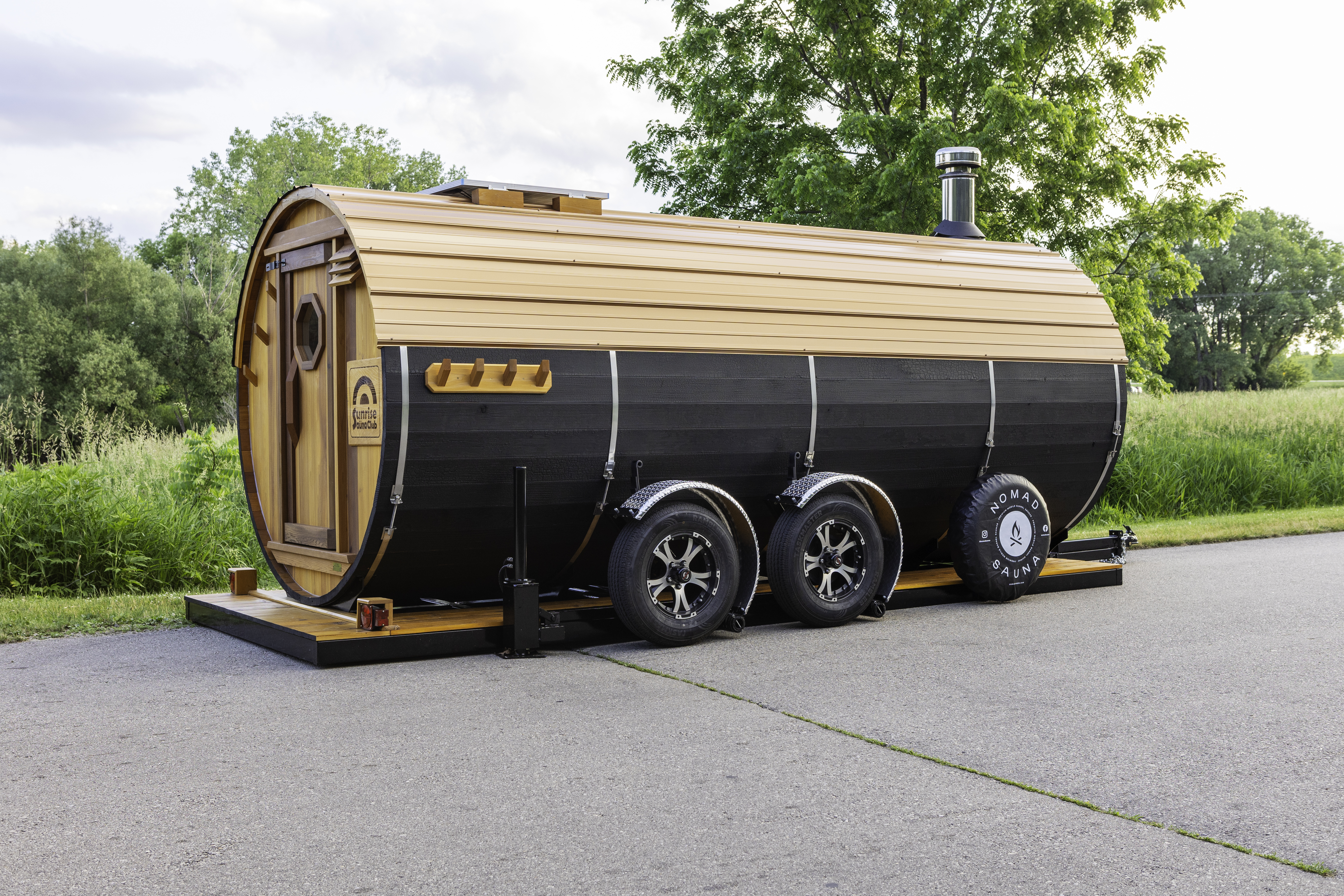
A mobile sauna business rents a sauna that travels to the customer: a backyard, a lakeshore, a brewery lot, a wedding venue. Starting one takes six things: a purpose-built trailer sauna, a legal entity, commercial liability insurance, a signed waiver, a permitting path for where you will operate, and a way to get booked. The unit is the biggest cost and the hardest decision to reverse. Everything else you can set up while it is being built.
We have built more than 100 mobile saunas by hand in Hudson, Wisconsin since 2018, delivered them to owners in more than 30 states, and watched the fleet pass 100,000 miles on the road. This guide is what we tell operators on the first call: the models that work, what to buy, what to file, what the math looks like, and who should not do this.
Is there a business here?
Demand for what a sauna delivers is not in doubt. The Global Wellness Institute puts the global wellness economy at $6.8 trillion in 2024 and forecasts growth of 7.6% a year to nearly $9.8 trillion in 2029. The health research behind sauna use is also real. A review in Mayo Clinic Proceedings describes cardiovascular responses to sauna heat that resemble moderate exercise, along with associations between regular use and lower cardiovascular mortality.
The business case is simpler than either number. A sauna has a thin marginal cost. Once the stove is hot, the next guest costs almost nothing, which is why a session priced per seat or per booking can carry real margin. The catch is the same one any rental asset has: it earns only when it is booked. One operator writing in Sauna Times puts it bluntly: "Winters will not be at 100% capacity, summers not even close," and a single drop-off unit makes modest income at best. Plan for that from day one.
Pick a business model
Mobile sauna businesses tend to fall into three models, and many operators run more than one over time.
Pricing ranges come from operators' own published rates and what we see in the field. We break them down in the mobile sauna rental pricing guide.
1. Private rentals
You rent your sauna to individuals and to short-term rental homes, especially if you live in an area with high tourism. Expect to do some networking, and probably to bring the sauna to events for a while as you get your name out and get people enjoying it. We have seen investors clear a profit in year one with this model. Repeat clients count too: we have a client who rents to a G League basketball team, and the visits repeat. One steady client like that can anchor your calendar between individual bookings. On paper, this is less involved than the other two models. It also needs no public-land permit, pays in full whether or not the unit is full, and builds the insurance record, reviews, and photos that open doors later.
2. Pop-ups and events
You bring the sauna to marathons, festivals, and other events. Sometimes you are paid to be there. Sometimes you pay for the spot and charge entry. You can also put on one-off events in partnership with businesses or influencers, which is often where a new operator gets the photos and the audience that private rentals then draw on.
3. Community membership
This is by far the most involved model, and the most reliable and lucrative. You commit to being in one place indefinitely, typically next to a natural body of water. We have clients on Lake Michigan, Puget Sound, the California coast, and the Deschutes River who are doing exceptionally well with it.
If you go this route, plan for growth and build in scaling mechanisms from the start. Hire help, and write your systems and SOPs immediately, not after the calendar fills. A permanent site also means a landowner agreement and whatever permits, insurance terms, and health rules apply at that specific location, so work through the legal setup below before you commit to a spot.
The community model is also the best way to generate leads for private rentals, provided you build an email list and show people a good time. The people who love a session by the water are the ones who book the sauna for their own cabin or rental home.
How to choose
Two questions sort the models quickly. How many hours a week can you actually give it? Private rentals suit a full-time job with a side business. Events and community sites need you there, so they suit someone building toward full time. And where do your customers already gather? A lakeshore town with cabin rentals favors private rentals. A city with festivals and races favors pop-ups. A waterfront with steady foot traffic and a landowner who wants you there favors community. Pick the model that matches your answers, run it for a season, then add a second.
Choose the unit
This is where the business is made or lost. A mobile sauna has two jobs at once: it is a heat chamber that cycles hot and cold, and it is a vehicle that takes road vibration for thousands of miles. Most of what goes wrong with cheaper units is the trailer, not the sauna.
The trailer is the product. Every Nomad Mobile Series unit sits on a purpose-built drop-down chassis with independent suspension, not a barrel bolted to a flatbed. The barrel is held by the Integrated Cradle Safety System: welded steel saddles locked to the chassis with steel-to-steel hardware, not wood screws driven into the staves. Wood screws back out under heat cycling and road vibration. That is why 100,000+ towing miles are real and not aspirational. Each unit ships with a VIN and title and is 102 inches wide, which keeps it road-legal.
The barrel has to survive commercial cycling. Cedar shrinks as it dries and swells as it absorbs moisture. A rental unit running multiple sessions a day cycles fast. A kit vs. custom-built comparison matters more in a business than in a backyard, because downtime is lost revenue. Our barrels are clear-grade Western Red Cedar with true 1.5" staves and band-compression joinery: no glues, no screws, and bands that tighten as the wood moves. The hand-charred Yakisugi exterior is available on every build. It weatherproofs the cedar, needs no seasonal treatment, and gives the unit a black finish people photograph.
Stoves: wood or propane. Not electric. Electric heaters need a dedicated 240V circuit most job sites do not have, and stones shift in transit and break elements. Wood-fired IKI is the default east of the Rockies, where fire bans are rare. Propane (Torch) is almost exclusively a West Coast choice, where seasonal fire bans push operators off wood for months. Match the stove to where you will operate, not to preference.
Sizing. The 8-foot unit seats 4 to 6, and the 20-foot seats 16 to 18.
Operators running a real business often choose the 12-foot: 8-to-10-person capacity covers private bookings and small events. Size up to 16 or 20 feet when you already have the events to fill it. Confirm your vehicle's rated towing capacity before you order; we provide towing specs for every unit. A standard driver's license applies in most states, but confirm with your DMV.
Operator options. Hydraulic lift (standard on the 16-foot wood-fired), solar lighting, a changing-room vestibule, hangers and cubbies, and custom branded window covers are all available, along with branding and signage on request. Commercial builds carry a 5-year build warranty, with the stove covered by its manufacturer.
Terms and timeline. Lead time is 3 to 4 months from deposit. Terms are 50% deposit, balance on delivery. We do not publish prices, because size, stove, and options change them: request a quote and we will spec the configuration to your market. The lead time is useful. It is the window to finish everything in the next section before the unit arrives.
Eight questions to ask any builder before you buy
Whoever you buy from, ask these. A builder who has engineered the unit for commercial mobile use will answer each one specifically.
- What is the trailer built on, and what is the suspension? Independent suspension or a through axle? An integrated cradle or straps on a flat deck? If the answer is vague, the trailer was an afterthought.
- What do the unit and the trailer weigh at the size you want? Get both numbers, then check them against your tow vehicle's rated towing capacity and tongue weight before you commit.
- Does it come with a VIN, serial number, and title? You need them to plate, insure, and operate the trailer without regulatory risk. Get confirmation in writing.
- What is the true stave thickness and the grade of wood? Ask for measured thickness, not nominal, and for the grade. Knots are potential failure points under repeated heating and cooling.
- How is the barrel held together? Screws fixed into end panels cannot move with the wood. Band-compression joinery can.
- Does the warranty explicitly cover commercial mobile use? A structural warranty that excludes road use does not cover your business.
- What is the real lead time? A unit that ships in 30 days was either already sitting finished, or built faster than good work allows. Lead time is a proxy for process.
- Can one person deploy it? Setup time, site requirements, and whether the unit can be run solo decide how many bookings you can take in a week.
Set up the legal side, in this order
- Form an LLC before your first paid booking. An LLC separates personal assets from business liability. State filing fees are commonly $50 to $200.
- Buy commercial general liability insurance. $1 million is the usual baseline that venues, event organizers, and parks departments ask for. Policies for mobile wellness operators commonly run $500 to $1,500 a year. Ask for mobile wellness or mobile spa coverage specifically, because generic event-vendor policies may not cover your actual activity. Keep certificates of insurance ready to attach to bookings.
- Use a waiver, every session, every guest. Have an attorney review it. It should cover heat exposure, hydration, pre-existing conditions, and the voluntary nature of the activity. Signed before entry, not buried in a booking email.
- Title, register, and insure the trailer. Ours ship with a VIN and title. Not every mobile sauna on the market is registrable, so confirm documentation in writing before you buy from anyone.
- Find out what your locations require. A sauna on a trailer chassis is generally treated differently from a building, and BW Sauna Co.'s operator FAQ notes that mobile saunas generally do not need building permits, while event-based operations may need temporary use permits and health department rules vary by state and county. Private property is the simplest place to start. Parks, public beaches, and events add requirements.
- Write your session procedure. Arrival checklist, setup, temperature check, safety briefing, maximum occupancy, emergency protocol. When a hotel, brewery, or parks department asks how you operate, a written procedure turns a risk conversation into a logistics one.
On public land, the rules are still being written in most cities. Minneapolis is further along than most: the city now licenses saunas under a 2025 ordinance, and the Park Board issues a Mobile Sauna permit. Most cities have no such category. The order that works: run insured, documented private bookings first, build a track record, then approach the parks department or venue as an operator already doing this safely. Cities tend to engage with operators who arrive with a record, not a request to be the first.
This article provides general information and is not legal, financial, or business advice. Permit requirements, business licensing, insurance obligations, and trailer regulations vary by state, municipality, and use case. Consult a licensed attorney, CPA, or local building official before making decisions specific to your situation.
Cold plunge and shared water: check before you buy
Contrast is a strong upsell. It is also where mobile operators run into rules. Shared, untreated standing water used by several people can spread infection: the CDC documents MRSA and Pseudomonas outbreaks tied to shared pool water. Some health departments treat a multi-user cold plunge like a public pool, with chemical treatment, testing, and inspection. Chlorinated water right after a session, when skin is warm and open, is its own problem. Natural cold water at a lakeshore or river sidesteps it. In places without water access, single-party plunges with a full water change between bookings are the lower-risk path. Ask your local health department before you invest in plunge equipment. More in the mobile sauna trailer guide.
The startup math
We will not tell you what a typical operator earns, because the honest answer is that it depends on how many bookings you fill. So here is the model, with the assumptions visible so you can change them. It models private rentals, the most common starting point. A community site has a different shape, with recurring members, fixed site costs, and staff, and is worth modeling separately once you have a location in mind.
Inputs: an average booking of $350 (between SeaTsu's $350 first night and Sweat Equity's $375 weekend rate). Direct cost of $75 per booking: about $20 of firewood, about $35 of tow fuel, and about $20 of consumables and laundry (the last is our assumption). Fixed costs of $235 a month: insurance at about $85 (from $1,000 a year) and $150 for booking software and marketing (also an assumption).
Months to recover each $10,000 of mobile sauna unit cost at different booking volumes, using the assumptions above. Source: Nomad Sauna model.
To use it, take your quoted unit price, divide by $10,000, and multiply by the last column. The table leaves out your labor, tow vehicle wear, taxes, and any financing. Every drop-off or attended booking also costs roughly two hours of your time between loading, driving, setup, and teardown, so 12 bookings a month is about 24 hours of work.
Two things change the picture. First, seasonality: if demand is concentrated in colder months, your bookings per month are lumpy, and a half-year of strong bookings roughly doubles the payback time. Second, the per-hour trap: an attended three-hour session can net less per hour of your time than a weekend drop-off. We work that through in the pricing guide.
This article provides general information and is not legal, financial, or business advice. The figures above are illustrations, not projections or guarantees of income. Consult a licensed attorney, CPA, or local building official before making decisions specific to your situation.
Plan your year around the seasons
Sauna demand is seasonal, but the seasons change what you sell, not whether you can sell. Build a calendar with a different product in each one.
Cold months. This is the natural peak for backyard and cabin drop-offs, because the contrast between a hot room and freezing air is the whole appeal. Holiday gatherings, corporate year-end events, and weekend getaways are the bookings to chase. Wood-fired units keep running well in sub-zero weather, which is a reason we build in Wisconsin.
Shoulder seasons. Spring and fall are when events, retreats, and venue partnerships fill in. Weddings, brewery and winery pop-ups, and corporate wellness days do not depend on snow.
Summer. Backyards go quiet, so move the unit to the water. Lakeshore rentals, marina and campground partnerships, and evening sessions at festivals carry the season. A sauna beside a cold lake sells itself, and guests get natural cold water without the plunge equipment and rules covered above.
The practical lesson is to decide your summer product before the winter ends. A calendar built for only one season leaves the unit idle in the others.
Get booked
A sauna on wheels markets itself when it is in front of people. A black Yakisugi barrel at a lakeshore is a photograph guests post, and each post is an ad. Build around that.
- Start with a simple booking page. Photos, prices, what is included, how delivery works, a calendar, a deposit. Nothing else is needed at launch.
- Shoot the unit the week it arrives. Golden hour, lakeshore or field, steam coming off the stove. These are your listing photos, your social content, and your venue pitch.
- Pitch venues with a use case, not a favor. Breweries, wedding venues, resorts, retreat centers, and gyms all have guests who would pay for a session. Offer a pilot weekend with your insurance certificate attached.
- Go after corporate wellness days. They book a group, often for a flat fee, and they repeat.
- Get listed. The Sauna Finder map shows where active Nomad saunas operate, which is useful for customers searching your area and for seeing where the market is already served.
- Collect reviews from the first booking. Ask every customer. Early reviews do more for trust than any ad.
Decide your policies before the first booking, because they are hard to introduce later. Set a minimum block so a short booking still covers your setup time. Take a deposit to hold the date, as several operators do. Write a weather and cancellation rule in plain language: a sauna in a light rain is lovely, but lightning and high winds are a reason to reschedule. Decide what is included in the base price, such as firewood, towels, and a bucket and ladle, and what is an add-on. Customers accept a clear policy easily. They resent one invented after a problem.
What a booking actually looks like
| Step | Time |
|---|---|
| Arrive, position, level, set up | 20–30 min |
| Light stove; heat-up runs while you brief the guests | 60–90 min, depending on ambient temperature and firewood quality |
| Safety briefing and waiver check | During heat-up |
| Session | The booking block |
| Wipe down, hose down, teardown | 20–30 min |
Maintenance is light if the build is right. Keep a written routine: inspect the bands and hardware, restack the stones yearly (see our sauna stones guide), check the chimney and stove on wood-fired units, and look over tires, bearings, and lights before each trip. Between bookings, hose down the cedar and run the stove with the door open. The cedar and the heat do almost all the cleaning, and you never need harsh chemicals.
Run a safe session
Your safety briefing is part of the product, and it is also your best protection. Keep it short and say it every time, before guests enter the sauna.
- Hydrate first, and skip alcohol. Drink water before the session. Alcohol dehydrates and makes it harder to judge how hot you are.
- First sessions are short. Ten to fifteen minutes is plenty for anyone new. Leave if you feel dizzy, nauseated, or lightheaded.
- Cool down between rounds. Step out, sit in the air, and come back when ready.
- Ask before throwing water on the stones. It changes the room for everyone. Show guests how to do it with one ladle at a time, as in our guide to building steam-rich löyly.
- Know your maximum occupancy and stick to it. It is on your waiver and your insurance.
- Keep the exit clear and keep water on hand. Have a first-aid kit and a plan for who calls emergency services and what address they give.
Guests with heart conditions, pregnancy, or other medical concerns should check with their doctor before using a sauna. Put that line on your waiver and on your booking confirmation.
Mistakes that stall first-year operators
Most stalled operators made one of these choices, and all of them are avoidable.
Buying on price. The cheapest unit is rarely the cheapest business. Downtime, repairs, and a trailer that cannot be titled all show up as lost bookings.
Underpricing to get started. A customer base built around a low price is hard to move later. Price above your floor from the first booking, and offer a limited pilot discount that ends.
Skipping the tow-vehicle math. Buying a unit and then discovering your truck cannot legally pull it is a common and expensive surprise. Check capacity first.
Starting with public land. Parks and public beaches require permits that often do not exist yet. Build a private-booking record first.
Ignoring seasonality. Plan your cash flow for slow months and build a summer calendar around lakes and events, not just backyards.
Waiting to market until the unit arrives. You have 3 to 4 months. Build the page, collect a waitlist, and line up your first venue conversations before delivery week.
Your first 90 days
| When | What to do |
|---|---|
| While the unit builds (3 to 4 months) | Form the LLC, get insurance quotes, have the waiver reviewed, confirm your tow vehicle, research permits for your first three locations, build the booking page, start a waitlist |
| Delivery week | Test-burn the stove, practice a solo setup and teardown twice, shoot photos and video |
| Days 1 to 30 | Run pilot bookings for friends and local businesses at a discount in exchange for reviews |
| Days 31 to 60 | Book your first event or venue partnership; record what sold and what did not |
| Days 61 to 90 | Adjust your prices and minimums, add your first upsell, decide whether demand justifies a second unit |
Who this is not for
A mobile sauna business is physical work. You load, tow, set up, tend a fire, and tear down, often on weekends and holidays. It is seasonal in most markets. A single drop-off unit is a modest side income unless bookings are steady. If you want passive income with no operation, this is not it. If you like logistics, hosting, and building something local, it can be a strong business with an asset that keeps its value.
FAQ
How much does it cost to start a mobile sauna business?
The unit is the largest cost and depends on size, stove, and options, so we quote it per build. Plan separately for an LLC (commonly $50 to $200), commercial liability insurance (commonly $500 to $1,500 a year), a waiver review, a tow vehicle rated for the trailer, and marketing. Request a quote for the unit.
Do I need a special license to tow a mobile sauna?
A standard driver's license applies for most U.S. states, but confirm with your DMV. Match your vehicle's rated towing capacity to the unit's weight.
How much can a mobile sauna business make?
It depends on bookings per month, your price per booking, and your costs. The startup math above shows net income at four booking volumes so you can test your own assumptions.
How long does it take to get a mobile sauna built?
Our lead time is 3 to 4 months from deposit, with 50% due at deposit and the balance on delivery. Use that window to finish your legal setup and booking page.
Should I choose wood-fired or propane?
Wood-fired is the default in most of the country. Propane is almost exclusively a West Coast choice because of seasonal fire bans. Choose by where you will operate.
If the numbers fit your market, the next step is a conversation. Book a 30-minute consultation and tell us where you plan to operate and which models you want to run. We will spec the right Mobile Series unit for it. You can also email sales@nomadsauna.com.
References
- Global Wellness Institute. 2025 Global Wellness Economy Monitor.
- Laukkanen, J.A., Laukkanen, T., and Kunutsor, S.K. Cardiovascular and Other Health Benefits of Sauna Bathing: A Review of the Evidence. Mayo Clinic Proceedings 93(8), 2018.
- Litt, W. So you want to start a mobile sauna business? Sauna Times, April 24, 2025.
- Operator rate pages checked September 30, 2026: Sweat Equity Mobile Sauna, SeaTsu Sauna, Sisu Mobile Sauna, 612 Sauna Cooperative.
- City of Minneapolis. Sauna license. Minneapolis Park and Recreation Board. Mobile Sauna permits.
- BW Sauna Co. Starting a Mobile Sauna Business: Questions Operators Ask.
- Centers for Disease Control and Prevention. Preventing Lice, Pinworms, and MRSA at the Pool; Pseudomonas Infection Outbreak Associated with a Hotel Swimming Pool, Maine, March 2023. MMWR 73(2), 2024.
Related saunas
- Custom mobile sauna trailers — Purpose-built trailers for operators and events — built in Hudson, WI.
- Custom barrel saunas, built to order — Backyard, mobile, floating, and commercial builds. No kits.