Wellness 7 min read
How Hot Should a Sauna Be? Temperature Guide
By Nomad Sauna
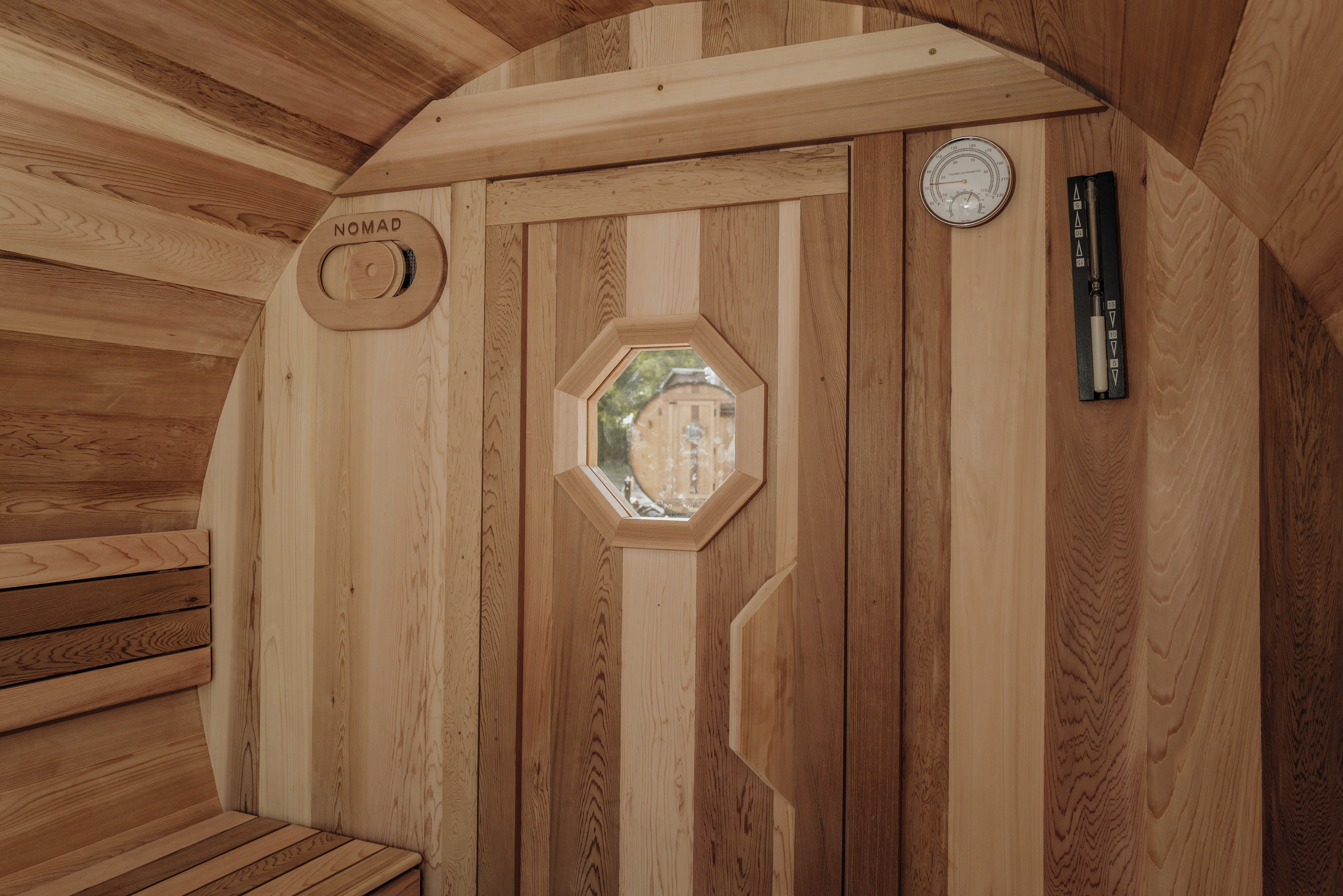
How Hot Should a Sauna Be? Temperature Guide
The Number Alone Is Not the Full Story
The thermometer reading inside a sauna is only part of the heat equation. The other variable is humidity, specifically löyly: the steam released when water hits the hot stones on the stove.
A dry sauna at 180 degrees and a sauna at 180 degrees with active steam from löyly are different experiences. The thermometer does not move. The feeling does.
Two things happen when steam enters the air. Water conducts heat more effectively than air, so steam transfers thermal energy to the skin faster than dry heat alone. At the same time, high humidity slows the skin's ability to cool itself through sweat evaporation. When moisture builds on the surface, it cannot evaporate as easily, so the body's primary cooling mechanism stalls. The result is an increase in perceived heat with no change in the thermometer reading.
This is why a well-designed sauna with adequate stone coverage can feel deeply satisfying at 175 degrees with moderate steam, while a poorly designed one at the same temperature feels sharp and unpleasant.
Targeting a temperature number without understanding how your stove and stones behave with steam misses the point. Experienced sauna users learn to manage heat perception through the balance of temperature and löyly rather than chasing a single degree reading.
Bench Height
Heat rises. In any sauna, there is a significant temperature gradient from floor to upper bench.
In a box sauna with a flat ceiling, that gradient can span 40 to 60 degrees Fahrenheit across five feet of vertical distance. The upper bench is scorching; the floor is warm.
In a well-built barrel sauna, the cylindrical shape creates a natural convection loop: hot air rises from the stove, follows the curve of the ceiling, and rolls back down along the walls in continuous circulation. This narrows the temperature contrast to roughly 20 to 30 degrees. The temperature is more even throughout the space, which means every seat in the sauna is a usable seat.
Stove Placement and Stone Mass
Where the stove sits inside a barrel affects everything from floor temperature to löyly quality.
Kit barrel saunas almost universally use wall-mounted electric heaters. The unit mounts to the wall at bench height with a small rock cage above the heating element. It is a practical choice for flat-pack assembly, but the stone mass is limited, the rocks sit high and away from the floor, and radiant heat aims outward from chest height. The floor stays cool. The löyly is constrained by the amount of rocks.
A floor-standing stove with rocks extending to floor level changes the equation. Radiant energy comes off the stones in all directions, including toward the floor surface surrounding the stove. The floor near the stove gets much warmer than in a wall-mounted configuration. More importantly, greater stone mass means greater thermal storage. When water hits a large volume of properly heated rocks, the steam is sustained and consistent rather than sharp and brief. Repeated pours do not drop the stone temperature fast enough to matter.
Nomad builds its custom barrels with floor-standing stoves and stone coverage that runs to floor level. It is not a universal feature of premium barrel saunas. It is a design choice that reflects what the sauna is expected to do with heat, session after session. This is one of the many reasons Nomad barrels are built differently from the rest of the barrel market.
Infrared "Saunas" Are Not Saunas
Infrared saunas do not reach traditional sauna temperatures. Most operate between 110 and 140 degrees Fahrenheit. Some are marketed specifically because they stay cool enough to sit in comfortably for long periods. That is a different product, not a cooler version of the same one.
The mechanism is different. Infrared heaters emit radiant wavelengths that penetrate the skin and warm the body directly rather than heating the air around it. There is no convection, no steam, and no possibility of löyly. You cannot pour water on an infrared panel. Sweating happens, but it is a fundamentally different process than full immersion in a hot air environment.
The health research most commonly cited for sauna use, including the Finnish cohort studies on cardiovascular mortality, is specific to traditional high-heat bathing in the 160 to 195 degree range. Infrared studies exist and some show benefits, but they are not the same literature. The physiological response to 130 degrees of radiant infrared is not the same as 180 degrees of hot air with steam.
Whether infrared has merit on its own terms is a separate question. What it is not is a sauna in any meaningful Finnish or thermal sense. The temperature, the mechanism, and the expected results are different enough that treating them as interchangeable does anyone shopping a real disservice.
Temperature by Experience Level
Beginners: Start at 150 to 160 degrees, light steam for the first several sessions. Keep sessions to 8 to 10 minutes. The body adapts to heat stress the same way it adapts to physical training: gradually, with time. Starting at the upper end of the range and pushing session length before your body has adapted is the most common reason first-time users have a negative experience.
Intermediate users: After regular use, most people comfortably settle into 170 to 180 degrees with moderate steam. Sessions of 15 to 20 minutes become sustainable. This is the range where most of the cardiovascular and metabolic research is centered.
Experienced users: 180 to 190 degrees with active löyly is where traditional Finnish sauna culture lives. Sessions in this range are intense. The Finnish practice of alternating between sauna rounds and cold water (lake, plunge pool, or cold shower) manages the cumulative heat load and makes longer total session time practical.
What the Research Says
The most-cited longitudinal data on sauna temperature and health comes from a 20-year Finnish cohort study following roughly 2,000 middle-aged men. The findings on cardiovascular mortality are specific to the 160 to 195 degree range, and the effects depend on both temperature and frequency.
The study found that men who used the sauna four to seven times per week had approximately 50 percent lower risk of fatal cardiovascular disease compared to once-per-week users. Men who used it two to three times per week had a 24 percent reduction. The meaningful variables were how hot and how often, not duration alone.
At temperatures above 160 degrees, the heart rate climbs to 100 to 140 beats per minute, cardiac output roughly doubles, and peripheral blood vessels dilate significantly. The cardiovascular system is doing real work. Heat shock proteins activate. Growth hormone release increases. The body's response to sustained heat stress at this range produces benefits that accumulate with regular use.
The important caveat: core body temperature rising by 1 to 2 degrees Celsius is the threshold where meaningful physiological adaptation begins. Time to reach that threshold depends on sauna temperature, individual physiology, and whether steam is being used. It is not simply a matter of sitting at 185 degrees for a set number of minutes.
How Barrel Saunas Handle Temperature Differently
The cylindrical shape of a barrel sauna is not an aesthetic decision. It is structural and thermal.
As described above, the curved interior produces continuous convective air circulation that box saunas do not generate. The practical result is a temperature environment that is more consistent throughout the space, more responsive to steam, and more efficient to maintain at the target range.
In cold climates, a well-insulated cedar barrel also holds heat between rounds more effectively than a flat-wall structure of comparable interior volume. The combination of clear-grade Western Red Cedar walls and band-compression construction means the staves breathe and release moisture naturally between sessions, keeping the barrel dry, tight, and ready to heat quickly.
Frequently Asked Questions
What temperature should I set my electric sauna heater to?
For most users, a starting set point of 175 to 185 degrees Fahrenheit at the heater's controller is a reasonable starting point, with the understanding that the actual temperature will stabilize differently depending on the sauna's interior volume, insulation, and how recently it was last used. A cold sauna on a cold day takes longer to stabilize than a pre-warmed one.
How long does it take to heat a barrel sauna?
A well-insulated cedar barrel sauna with a properly sized stove (measured in kilowatts relative to interior cubic footage) typically reaches 170 to 180 degrees within 75 to 90 minutes. A wood-fired stove generally reaches temperature faster than electric, particularly in cold conditions, because the heat output is immediate and sustained at peak intensity throughout the fire.
Does a hotter sauna mean more health benefits?
The research suggests diminishing returns above 185 to 190 degrees Fahrenheit. The documented cardiovascular and hormonal benefits are associated with the 160 to 195 degree range with regular use. Pushing to 200 degrees or above primarily shortens how long most people can remain in the sauna, which reduces total session time and does not increase the physiological stimulus proportionally. Frequency and consistency are more predictive of health outcomes than peak temperature.
Is 150 degrees hot enough for a sauna?
At 150 degrees, you will perspire and experience relaxation benefits. Cardiovascular stimulus and the hormonal responses associated with deeper sauna research are more pronounced at temperatures above 160 degrees.
If you are building toward a regular sauna practice, the heater and stove setup inside the sauna determine how consistently and reliably you can hit your target temperature range. See the wood-fired vs. electric sauna stove comparison for a full breakdown, or request a quote for a custom cedar barrel sauna built for your site and climate.
Related saunas
- Custom backyard barrel saunas — Delivered fully assembled, ready to fire the first night.
- Custom barrel saunas, built to order — Backyard, mobile, floating, and commercial builds. No kits.