Mobile Sauna Business & Lifestyle 14 min read
Mobile Sauna Trailers: What to Buy, What to Avoid, and What the Business Actually Looks Like
By Nomad Sauna
Mobile Sauna Trailers: What to Buy, What to Avoid, and What the Business Actually Looks Like
Author: Nomad Sauna · 14 min read
A mobile sauna can take a lot of forms. Most buyers start with a general search and end up navigating a category that's less standardized than it looks. Understanding what you're actually choosing between — before you get into specs and pricing — saves a lot of time.
There are two base configurations in the market, and one sauna type that performs better than the others in a mobile context.
Cargo trailer conversions. An enclosed cargo trailer — the kind used for moving equipment or merchandise — retrofitted as a sauna. The appeal is straightforward: the shell is already road-legal and partially insulated, entry cost is lower than a purpose-built unit, and the enclosed form factor gives you a changing area and weather protection in one package. Some operators run these successfully, particularly for private bookings where aesthetics matter less than function.
The limitations are structural and commercial. Cargo trailers are engineered for ventilation and load distribution, not heat retention. Converting one into a sauna means fighting the geometry at every step: flat walls lose heat faster than curved ones, ceiling height is often marginal for a proper standing sauna experience, and vapor management — critical for both comfort and long-term structural integrity — requires retrofitting that the original shell wasn't designed to support. The seams, doors, and wall panels that make a cargo trailer functional for freight are the same features that make sustained sauna temperatures harder to hold and harder to seal over time. What looks like a cost-effective starting point tends to reveal itself through repair bills and performance complaints. For commercial use with repeated thermal cycling, these compromises accumulate fast.
There's also a marketing problem that's easy to underestimate: nobody knows what's inside. A cargo trailer on the road is a cargo trailer. It doesn't turn heads. It doesn't generate questions. It doesn't make the people who see it want to book a session. For an operator whose unit is also their primary marketing asset — showing up at events, parked at a lakefront, towed through town — that anonymity has a real cost.
Mobile sauna trailers — cabin style. A custom sauna structure — most commonly a cedar-clad cabin — built on a custom-welded aluminum or steel trailer frame. This is what companies like Voyageur Custom Saunas build: a purpose-designed sauna room integrated with a flatbed trailer, typically 7 feet wide by 12 or 14 feet long, with a separate changing room, wood-fired heater, and solar lighting. Voyageur's standard mobile unit comes in at 2,300 lbs dry weight on 3,500 lb spring axles, with a 2-year warranty and pricing starting around $12,500 for the shell alone.
The cabin style has real advantages: a dedicated changing area, standing headroom, and a rectangular interior that some buyers prefer. For private property owners or operators where the indoor-outdoor changing experience matters, it's a legitimate option from builders who take it seriously.
The structural limitations are the same as any flatbed build. Standard spring axles transmit road shock directly across the frame and into the sauna above — there's no independent absorption. At 2,300 lbs dry, the units are lighter than a purpose-built barrel, which helps on fuel economy and tow vehicle requirements. But the rectangular geometry still concentrates thermal stress at corners and seams over years of cycling, and the cabin form — however well-built — doesn't generate the same instant recognition on the road that a barrel does.
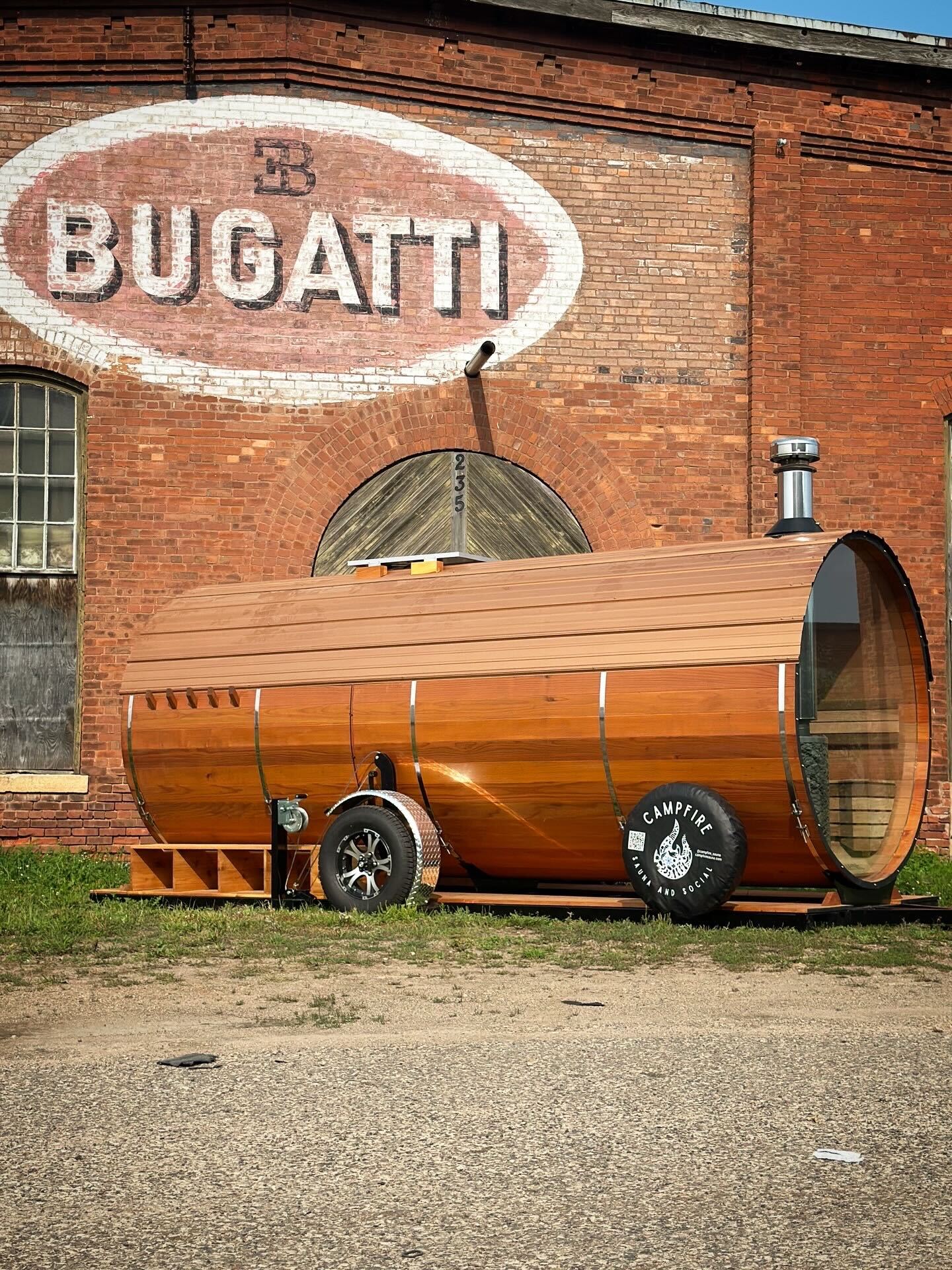
Purpose-built barrel saunas. A barrel sauna on a trailer engineered specifically for that barrel — where the frame, suspension, mounting geometry, and sauna construction were designed as one system. This is the least common form in the market and, for commercial use, the most durable. Most companies still just plop a kit sauna onto a trailer.
The barrel form has specific structural advantages in a mobile context. The geometry — a cylinder rather than a box — distributes thermal stress across the full circumference of the stave assembly rather than concentrating it at corners and seams. The same curve that makes a barrel sauna visually distinctive is also what makes it handle repeated heating, cooling, and road vibration better than a flat-sided structure over time.
There's also something that doesn't show up in a spec sheet: a barrel sauna is unmistakably a sauna. Nobody drives past one and wonders what it is. Towed to a lakefront, parked at an event, or staged at a corporate campus, it announces itself. For a rental operator, that visibility is part of the product — the unit generates its own leads every time it moves. For a property owner, it signals something intentional about the space it's sitting in. A prefab box on a flatbed doesn't do that. A cargo trailer certainly doesn't.
For a full breakdown of barrel construction — wood species, stave thickness, joinery methods, heater selection, and what separates a well-built barrel from a kit — the Barrel Sauna Buyer's Guide covers it in detail. Everything in it applies to a mobile build, and several things matter more.
What all three forms share is the fundamental challenge of the category: a sauna is a thermal environment that lives and breathes through temperature cycles, and it also needs to travel. Most builds solve one of those problems adequately. Few solve both.
The traveling part is consistently where mobile saunas fail. Most manufacturers treat the trailer as a platform — something to put the sauna on — rather than as a structural system that has to absorb tens of thousands of miles of road input without transmitting that load into the heat chamber above it. The sauna gets designed first. The trailer gets figured out after. The result is a unit that performs fine at delivery and starts showing stress after a season of commercial use: joints that loosen, mounting points that develop play, thermal cycling that compounds the movement road input already started.
We've logged over 100,000 miles on Nomad mobile units. The engineering that makes a mobile sauna reliable starts before the sauna itself — with what you're mounting it on, how you're mounting it, and whether the whole system was designed to work together or assembled after the fact.
Who Actually Buys a Mobile Sauna Trailer
Two types of buyers come to us, and they're making different decisions.
The operator. They're building a rental or event business — deploying the sauna to private bookings, farmers markets, wellness retreats, corporate events, lakeside locations. The trailer is a revenue-generating asset. The question is whether the economics work. They do — but only if the unit is built for commercial use from the start.
The property owner who needs flexibility. A lakefront property in Wisconsin and a city lot in Minneapolis. A venue still being built out, where a sauna is needed for events in the meantime. A vacation rental where it's part of the offering but permanent installation isn't practical. For this buyer, the trailer isn't about revenue — it's about a proper sauna that isn't fixed to one location permanently. In most jurisdictions, a mobile sauna used on private property doesn't require a permit at all — one of the underappreciated advantages of the trailer form over a permanent installation.
The underlying question is the same either way: what does a mobile sauna trailer need to be to perform at a high level for years? The answer starts with the trailer itself, and most manufacturers get it wrong.
The Trailer Is the Product
Most buyers focus on the barrel. That's understandable — the barrel is what you sit in. But for a mobile unit, the trailer is where performance is made or lost over the long run, and it's where manufacturers consistently cut costs that buyers only discover after a few thousand miles.
A standard commodity trailer uses a through axle: a single steel bar running the full width, connecting both wheels. When one wheel hits a bump, the vibration transfers directly across to the other wheel and from there through the frame and into whatever's loaded on the deck. That's acceptable for pallets of lumber. It's mechanically destructive for a barrel sauna that's already managing wood movement from repeated heating and cooling cycles. Road vibration doesn't add to the thermal movement — it compounds it, working against the same stave-to-stave joints that temperature cycles are already stressing.
A purpose-built mobile sauna trailer uses independent suspension. Each wheel absorbs road input on its own without transferring shock across the axle. The difference in what reaches the barrel over 100,000 miles is not subtle. It shows up in the longevity of the build and in customer experience. This is a structural engineering decision, not a comfort feature.
The second issue is cradle design. Most trailer builds secure the barrel with adjustable straps or a basic mounting frame. The barrel rests on the deck and is held against lateral movement — but the contact between a cylinder and a flat surface is inherently wrong. Pressure distributes at the tangent line, not across a surface, and it shifts as the wood moves thermally. A barrel sauna is not a static load, even sitting still.
Every Nomad mobile unit uses the Integrated Cradle Safety System — the barrel doesn't rest on a deck, it's held by a frame engineered to match the barrel's geometry. Weight distributes correctly, the barrel doesn't develop lateral rock under braking or acceleration, and the whole assembly moves as a unit over the road. On 16-foot and 20-foot builds, a hydraulic lift system is standard — the barrel raises and lowers for deployment and repositioning without manual lifting or rented equipment on site. On smaller builds it's available as an upgrade worth considering for any operator running consistent commercial volume.
Every unit ships with a VIN, a serial number, and a title. Some mobile sauna builds are technically unregistrable — that becomes a problem the moment you're pulled over, cross a state line, or your commercial liability carrier asks for documentation. Our units are 102 inches wide, street-legal on all US roads, and fully documented from day one. The 5-year structural warranty covers the full assembly.
The Barrel Itself
The mobile context puts two additional stresses on barrel construction that stationary installs don't face: road vibration and accelerated thermal cycling. A residential backyard sauna heats up and cools down a few times per week. A commercial mobile unit might run two or three sessions in a day — deployed at six in the morning, returned at midnight. That's more thermal cycles in a month than most stationary saunas see in a year.
The construction answer: clear-grade Western Red Cedar, true 1.5-inch staves (not nominal — true), band-compression ring joinery with no glues and no screws in the barrel assembly, floor drains standard, ½-inch tempered glass. The same build that makes a stationary Nomad sauna last 30 years is what goes on the trailer.
Kit construction — staves screwed permanently into end panels, unable to move freely through thermal expansion — degrades faster in mobile applications than stationary ones. Road vibration works the screws loose before the thermal cycling even begins in earnest. A custom-built barrel with band-compression ring joinery moves freely with the wood, handles the cycling, and has no fastener points accumulating road stress. For a full breakdown of what separates kit construction from custom-built, the Barrel Sauna Buyer's Guide covers the math and the mechanics in detail — the mobile context makes every point in that section matter more, not less.
The Yakisugi exterior finish is available on mobile builds. Hand-charred Western Red Cedar — the same 18th-century Japanese technique applied in the Hudson shop. For operators building around an elevated brand, or property owners who want no exterior maintenance, it's the same finish as on a stationary unit: charred cedar that protects itself. No seasonal treatment required.
Sizing: What the Numbers Mean in Practice
Mobile saunas are available in five standard lengths. The size you need depends on who you're serving and what you're towing.
| Sauna Size | Seating | Total Trailer Length | Loaded Weight | | :---- | :---- | :---- | :---- | | 8 ft | 4–6 people | 14 ft | \~2,700 lbs | | 10 ft | 6–8 people | 16 ft | \~2,900 lbs | | 12 ft | 8–10 people | 18 ft | \~3,700 lbs | | 16 ft | 12–14 people | 22 ft | \~4,200 lbs | | 20 ft | 16–18 people | 26 ft | \~5,500 lbs |
All sizes are 102 inches wide — street-legal everywhere.
How Nomad compares to other mobile sauna builders
The table below compares the major builders in the US market across the specs that matter for commercial use. Voyageur builds cabin-style mobile saunas on aluminum-frame flatbeds out of Chaska, MN. BW Sauna builds cabin-style units on steel-frame flatbeds out of Minnesota, with models ranging from 8 to 14 feet. Both are legitimate builders making real products — the differences are in form factor, suspension, construction approach, and what each unit is designed to handle over time.
| Spec | Nomad Sauna | Voyageur Custom Saunas | BW Sauna Co. | | :---- | :---- | :---- | :---- | | Form | Purpose-built barrel | Cabin on aluminum flatbed | Cabin on steel flatbed | | Sizes available | 8–20 ft | 7×12 ft, 7×14 ft (XL: 18–28 ft custom) | 8, 10, 12, 14 ft | | Seating capacity | 4–16 people | 4–6 people (standard) | 4–8 people | | Trailer width | 102 in (street-legal everywhere) | 84 in | Not published | | Suspension | Independent | Spring axle (3,500 lb) | Not published | | Sauna mounting | Integrated Cradle Safety System | Welded to aluminum frame | Welded to steel frame | | Frame material | Steel | Aluminum | Steel | | Interior wood | Clear-grade Western Red Cedar | 1×6 premium cedar T\&G | Thermory thermally modified | | Stave/wall thickness | 1.5" true | 2" spray foam walls | Not published | | Stove type | Wood or propane | Wood-fired (IKI or Kuuma) | Wood-fired (recommended) | | Changing room | Optional | Standard (4×7 ft) | Standard on 12 ft+ | | Hydraulic lift | Standard (16 ft+), optional (smaller) | Available (XL models) | Not offered | | VIN / road title | Yes | Yes | Yes | | Warranty | 5 years (full assembly, commercial mobile) | 2 years | Not published | | Lead time | 3–4 months | 8–12 weeks | 8 weeks |
A few things worth noting when reading this table. The spring axle on Voyageur's standard trailer is a meaningful difference for commercial operators: it's the through-axle design that transfers road shock directly into the sauna structure, versus the independent suspension on Nomad units. And the barrel form itself doesn't appear on either competitor's mobile lineup — it's a Nomad-specific approach in the commercial mobile category.
The 8-foot and 10-foot are entry points — useful for private property owners who need flexibility, or operators testing a market before committing to a larger unit. The capacity ceiling is the limiting factor: most private rental markets price on the booking, not per person, and a 4-to-6-person maximum constrains both what you can charge and the group sizes you can serve. For a business built on consistent commercial volume, these are a starting point, not a destination.
The 12-foot is where most operators running a real rental business land. At 18 feet total and 3,700 pounds, it tows with a 3/4-ton pickup — confirm your vehicle's gross combined weight rating and tongue weight capacity before ordering, as most half-ton trucks are at their limit here. The 8-to-10-person capacity covers private rentals, couples-and-friends bookings, and small events without the logistical step-up of a larger unit. Versatile enough for a first serious commercial deployment and capable enough to stay in rotation as the operation grows.
The 16-foot is the workhorse of established mobile sauna operations. At 22 feet and 4,200 pounds, you're in 3/4-ton or 1-ton territory with a proper hitch setup. This is a business vehicle. The 12-to-14-person capacity is the right scale for event operators, retreat centers running back-to-back sessions, corporate wellness days, and resort properties with consistent high-demand periods.
The 20-foot is purpose-built for scale: festivals, large corporate events, high-volume commercial properties. Two stoves running together. Operators who buy them already know what they're deploying into.
Stove Options: Wood-Fired or Propane
There is no viable electric option on a mobile sauna.
First: electric heaters require a dedicated 240V circuit, typically 40 to 60 amps. Most deployment locations don't have that available, and running generator power at that draw adds noise, exhaust, and operational complexity that undermine the session. Second: electric sauna heaters are engineered for fixed installations. Heating elements and stone configuration are calibrated for a level, stationary environment. Road travel introduces vibration and load shifts the elements can't handle over time. When an element fails in a commercial unit, the business stops. There's no field fix. Mobile saunas run on wood or propane. Both work well. The choice depends on how you operate.
Wood-fired
A quality wood-fired stove — stone-loaded, properly sized, with good stone coverage at floor level — produces the soft, enveloping heat that defines a real sauna session. The stone mass is what gives you löyly worth throwing: water hits hot stone, vaporizes evenly, and produces the steam that serious sauna users come back for.
The practical consideration in a rental business: firewood logistics. You need dry hardwood at every deployment. For operators with an established local route and repeat customers in a defined area, this is manageable — bundle firewood as an add-on, keep a supply in rotation. For operators doing festival work or traveling to venues they don't control, local sourcing adds a coordination step.
The wood-fire experience is also part of what you're selling. The ritual of building the fire, the sound of it, the visual of an open flame — it's a different product than propane. If you're positioning around authentic sauna culture, wood-fired delivers an experience propane doesn't replicate.
Propane
A properly spec'd propane stove is consistent, controllable, and logistically simple. Heat-up time is predictable regardless of who's running the session. For commercial use, the key criteria are BTU output matched to room volume, reliable ignition, and a design built for repeated commercial cycles.
Consistency matters in a rental business. A well-built fire with good dry wood produces excellent heat, but a fire built wrong with damp wood produces a frustrating session. Propane removes that variable. A solar lighting kit pairs naturally with propane — it eliminates any need for shore power at deployment sites, which matters for remote locations and off-grid properties. (+$1,500)
The Business Case
The mobile sauna rental business is real. It's been real in Scandinavia for decades, and it's arrived in the US. The market works because the product is excellent — a session in a quality sauna is a $40 to $75 wellness experience, delivered to someone's backyard or event space, with none of the facility overhead a brick-and-mortar wellness business carries.
The global wellness economy hit $6.8 trillion in 2024 and is projected to reach $9.8 trillion by 2029, driven significantly by the shift of wellness experiences out of destination spas and into everyday life.¹ The sauna services segment specifically is growing at approximately 10.4% annually and is on track to nearly double in value by 2030.²
What gives the category its durability is that sauna use is backed by real research. A review published in Mayo Clinic Proceedings documented that the physiological responses to sauna heat closely resemble moderate aerobic exercise, and that regular sauna use is associated with substantially reduced cardiovascular mortality, lower dementia risk, and improved metabolic markers.³ The people booking mobile sauna sessions aren't paying $400 for novelty. They're paying for a health practice with 30 years of prospective cohort data behind it.
Minnesota is the most developed mobile sauna market in the country, and we know that from the inside — Nomad was one of the first mobile sauna rental operators in the state, building our own trailers to run sessions before the category had a name, before permitting frameworks existed. The infrastructure that exists in Minneapolis now — dedicated permit categories, an established customer base, operators who've built real businesses — wasn't there when we started. We built the units, ran the sessions, and eventually helped the City build the regulatory framework. The 612 Sauna Cooperative charges $35 per seat for 90-minute sessions at Hidden Beach on Cedar Lake, booking out regularly through the winter season.⁴
But Minnesota isn't the only market developing. The Pacific Northwest, Upper Midwest, and Northeast all have the demographics and the appetite. And what the US market still lacks is supply. In 2020, the North American Sauna Society documented one of the first US mobile sauna rental operations, describing the category as "few and far in between" nationally.⁵ Six years later, the market has grown considerably — but it remains early relative to where it's heading. The operators entering now are building the category, not fighting for share in a saturated one.
The numbers, laid out honestly.
Startup Costs
A commercially-built mobile sauna — purpose-built trailer, properly constructed barrel, commercial-grade stove, and delivery — runs between $35,000 and $65,000 in 2026 depending on size and configuration. That's the real number for a unit built to commercial standards. Anything below it is worth scrutinizing carefully: at lower price points, something is giving — materials quality, trailer engineering, stave thickness. The cost of a structural failure or a unit that needs major repair at year two doesn't just show up as a repair bill. It changes the breakeven math significantly.
On top of the unit: commercial liability insurance ($500 to $1,500 per year), permitting costs that vary by jurisdiction, and first-year marketing to build the booking base.
Revenue Models
Private rentals. You deploy the sauna to a customer's property for a defined session window, typically two to four hours. Pricing runs $250 per session on the lower end, $400 to $500 for peak weekend demand in established markets. Weekly rentals — the sauna stays at a property for a full week — run $1,000 to $1,300. For a unit booking six to eight weekend sessions per month at $350 average, that's $2,100 to $2,800 per month from private rentals alone.
Events. Corporate wellness bookings, wedding weekends, retreat centers, festival appearances — typically structured at $25 to $50 per person per session with a minimum booking guarantee. A full 12-foot sauna running $40 per person at a corporate event, with 14 people cycling through multiple sessions over a day, approaches $1,000 from a single booking. Event revenue is more variable than private rentals but typically commands better per-hour rates and generates word-of-mouth that private bookings don't.
Community membership. The most operationally demanding model — and, when it works, the most reliable and lucrative. You commit to a permanent or semi-permanent location, almost always adjacent to a natural body of water, and build a recurring membership base around it. We have clients operating this way on Lake Michigan, Puget Sound, the California Coast, and the Deschutes River. The revenue profile is fundamentally different from the other two models: members pay monthly or annually, demand is predictable, and the sauna becomes a destination rather than a service someone books once. The cold water access isn't incidental — it's the product. Heat, cold, repeat. No chemical plunge required.
The tradeoff is scale. Community membership models grow fast when they work, and the operational complexity grows with them. If you go this route, plan for it from the start: build your SOPs before you need them, hire help earlier than feels necessary, and implement booking and membership management systems before the waitlist forms. Operators who get this right also find it generates leads for private rental bookings — a community member who brings their company team out for a session is a natural bridge to a corporate event booking. Build the email list from day one.
![][image1]
Year-One Reality
Year one is a build year. You're establishing the customer base, building reviews, refining your deployment and setup process. Realistic Year 1 revenue for a first-time operator running part-time: $10,000 to $12,000. Running it as a primary focus with active marketing and event outreach: $15,000 to $18,000.
Year two, with an established customer base and repeat bookings filling the calendar: $15,000 to $20,000. Operators who add complementary services — contrast experiences, firewood bundles, robes and towels, group booking packages — hit the upper end of that range.
Some Nomad customers have paid off their units within the first year. That's the exception, not the expectation. It requires strong local demand, active marketing, and event-market access from day one. Breakeven for a typical first-time operator running part-time to moderate volume runs two to three years. After breakeven, the ongoing net from a well-run unit runs approximately $10,000 to $15,000 per year, with a capital asset that still has 15-plus years of commercial life ahead of it.
Seasonality
Sixty to seventy percent of annual revenue comes from October through March in most US markets. The operators who sustain strong numbers year-round build their summer calendar around waterfront deployments and events that aren't weather-dependent. A sauna beside a cold lake in July is a different offering from a suburban backyard in February — but it's compelling if you've built the customer relationships that make that deployment possible.
Cold Plunge: The Public Pool Problem
Contrast therapy is where mobile sauna revenue gets interesting. Operators who deliver both heat and cold see better per-session revenue and stronger customer retention than those running sauna alone. The issue is that portable cold plunge tanks are running into regulatory trouble across the country.
The regulatory concern is specific and legitimate: shared standing water used by multiple people is a documented vector for disease transmission. Staph infections — including MRSA — E. coli, Pseudomonas, and other waterborne pathogens can survive and spread in untreated water cycling through multiple users.⁶˒⁷ Health departments aren't classifying portable cold plunge tanks as public pools out of bureaucratic reflex. They're doing it because the public health risk is real, and their regulatory tools are built around pool chemistry.
That puts a portable cold plunge tank under the same framework as a commercial swimming facility: continuous chemical treatment, pH balance and chlorine testing, inspection schedules, and in some jurisdictions, a certified pool operator on site. For a solo mobile operator running a trailer to a private backyard booking, the compliance burden is significant. For public park or event deployments, it can make a portable plunge effectively unpermittable.
There's a separate problem with the chemical solution regardless of the regulatory question: sauna opens your pores. A proper session produces genuine physiological changes — elevated core temperature, significant vasodilation, real sweat volume — and skin is measurably more permeable immediately after. Immersing in chlorinated water at that moment means absorbing more of what's in that water than you would under normal conditions. That's not a wellness product.
Nomad saunas are built specifically for outdoor deployment at lakefronts, riverbanks, farm properties, and resort waterfronts. That's not just an aesthetic choice — it's the right way to do the contrast experience. Cold water from a lake or river sidesteps the regulatory exposure of a chemically maintained plunge tank, and the experience is better by every measure that matters to the people booking it.
For operators in markets without natural water access, natural-fill cold plunge barrels with complete water changes between sessions — not chemically maintained shared water — can work for private bookings. The regulatory problem arises with multi-session shared water. Know your local health department's position on this before you invest in contrast equipment — the answer varies enough by state that a setup that works in Minnesota may be a compliance problem in Florida or California.
Permits, Licensing, and Operating Legally
Nothing in this section is legal advice. Nomad Sauna is not a law firm, and the regulatory landscape for mobile saunas varies significantly by state, county, and city. Consult a licensed attorney in your jurisdiction before making business or compliance decisions.
This is the part of the mobile sauna business that nobody fully explains before you start, partly because the regulatory frameworks don't exist in most cities yet. The category sits between mobile food service, personal service businesses, and wellness facilities — and the department that "owns" it varies by city and state.
Form an LLC first. Before you take a single paid booking. A limited liability company separates your personal assets from any liability the business generates. In most states, the filing is $50 to $200 and takes under a week.
Get commercial liability insurance. A minimum of $1 million in general commercial liability is what most venues, event organizers, and parks departments require. Policies for mobile wellness operators typically run $500 to $1,500 per year. Shop specifically for mobile wellness or mobile spa coverage — generic event vendor policies are written for different risk profiles and may not cover your activity.
Build a proper waiver and use it every session. Every participant, signed before they enter. A waiver reviewed by an attorney that covers heat exposure risks, hydration requirements, pre-existing condition disclosures, and the voluntary nature of the activity. A few hundred dollars in attorney review time, used every session for the life of the business, is the cheapest insurance you'll buy.
Document how you run a session. Arrival checklist, setup procedure, temperature verification, safety briefing, maximum occupancy, emergency protocol. These aren't just operational discipline — they're the evidence that you're running a professional operation. When you approach a parks department, a hotel, or a corporate event team, documented SOPs turn the risk assessment conversation into a logistics discussion.
Minneapolis has the most developed mobile sauna regulatory framework in the country, in part because Nomad was one of the first operators in the market and worked directly with the City to develop it. The Minneapolis Park and Recreation Board now issues a dedicated Mobile Wellness permit.⁸ The City Council approved a full sauna licensing ordinance in June 2025.⁹ None of that existed when we started running sessions.
Most other cities aren't there yet. California illustrates the current state well. LA Recreation and Parks vending rules explicitly exclude personal services. San Francisco's Department of Public Health doesn't authorize parking or vending locations for mobile facilities. In fall 2025, California State Parks opened a 30-day public comment period for a single mobile sauna concession at Big River Beach — and a local environmental group filed complaints that killed even that.¹⁰
And yet operators are running there. California Sauna Club — running a Nomad trailer — is operating at Coleman Park in Morro Bay and SLO Ranch Farms, the first mobile sauna business on the Central Coast. Westside Sweat Club runs fleets across Southern California. Bay Area operators are at Crane Cove Park, Point San Pablo, and Pacifica every weekend. None of them waited for a permit category that fit. They did what the Minneapolis operators did: built a private rental business first — corporate events, private bookings, hotel partnerships, retreat weekends — with proper insurance, documented waivers, and a professional track record. Then approached the parks department not as applicants asking permission for something untested, but as operators already running insured, documented sessions who needed a public home for work they were already doing safely.
That's the right order of operations regardless of where permitting ends up in your city. Build the business. Earn the credibility. Then offer to help write the framework.
What to Look for When You're Buying
Most of the questions worth asking overlap with what's in the Barrel Sauna Buyer's Guide — construction method, stave thickness, wood grade, heater specs. The mobile context adds a few things a stationary buyer never has to think about.
1\. What is the trailer actually built on — and what's the suspension design? Ask directly: independent suspension or through axle? Integrated Cradle Safety System or straps on a flat deck? A builder who has engineered their trailer for this application will have clear answers with specific reasoning. One who bolted a barrel to a standard equipment trailer may not understand the question — which is itself informative. Also ask specifically how the sauna is secured to the trailer deck. Some kit builds screw directly through the wood decking into the sauna structure — this connection loosens over time as the deck flexes and the wood cycles. It's a weak point that shows up gradually, and most operators don't notice it until something has already moved.
2\. What is the total weight and total trailer length at the size you're considering? This determines what you need to tow it, legally and practically. Many operators underestimate this and find themselves with a unit their vehicle can't legally pull. Get both numbers, then verify your tow vehicle's gross combined weight rating and tongue weight capacity before you commit.
3\. Does it come with a VIN, serial number, and title? Not all mobile saunas are registrable as road vehicles. You need a proper title to plate the trailer, insure it as a commercial asset, and operate without regulatory risk. Get confirmation of full documentation before you purchase — in writing.
4\. What is the stave thickness (true, not nominal) and what is the construction method? True 1.5-inch clear-grade cedar, band-compressed with ring joinery, no screws fastening staves to end panels. The mobile context makes this matter more, not less.
5\. What is the warranty, and does it explicitly cover mobile and commercial use? A structural warranty that excludes road use is not a warranty for your intended application. Read the terms specifically for how mobile deployment is treated. Nomad's 5-year warranty covers the full assembly under normal commercial mobile use.
6\. What is the lead time, and what does that tell you about the build? A purpose-built mobile sauna takes time. Our lead time is approximately 3 to 4 months. A unit that ships in 30 days was either already sitting finished in a lot — worth asking why — or was built faster than the work requires. Lead time is a proxy for process.
7\. What are the realistic operating costs? Wood-fired: firewood at $15 to $25 per deployment day, sourced dry hardwood. Propane: per-session fuel cost at your local rate. Both: tow vehicle fuel at approximately $30 to $40 per round trip at typical rental distances. Commercial liability insurance at $500 to $1,500 per year. Model these before you price your first booking — operators who don't undercharge early and struggle to raise rates once the customer base is set.
8\. What does the full deployment and pickup process look like, and can you run it alone? Setup time, site requirements, solo vs. two-person operation, time from arrival to first session — these operational details determine whether the unit is practical at the booking volume you're planning. Know before you commit to a scheduling model.
Ready to Talk Through the Details
Every Nomad mobile sauna is built by hand in Hudson, WI with a full build history from the shop floor to the road. We've delivered units to rental operators across the country — from first-time entrepreneurs building their initial route to resort properties adding mobile service to an existing facility.
If you're pricing out a specific configuration, working through whether the business makes sense for your market, or figuring out the right size for what you're planning — reach out. Most of those conversations are about 20 minutes.
Browse our mobile sauna builds → Get in touch →
References
- Global Wellness Institute. 2025 Global Wellness Economy Monitor. November 2025\. globalwellnessinstitute.org
- Research and Markets. Sauna Services Market Size, Competitors & Forecast to 2030\. 2026\. researchandmarkets.com
- Laukkanen, J.A. et al. "Cardiovascular and Other Health Benefits of Sauna Bathing." Mayo Clinic Proceedings 93, no. 8 (2018): 1111–1121. mayoclinicproceedings.org30275-1/fulltext)
- 612 Sauna Cooperative. Pricing & Packages. 2026\. 612saunasociety.com
- Kilpi, E. "Spa Fleet Mobile Sauna Business." North American Sauna Society Blog. August 24, 2020\. saunasociety.org
- CDC. "Preventing Lice, Pinworms, and MRSA at the Pool." Healthy Swimming. cdc.gov
- CDC. "Pseudomonas Infection Outbreak — Maine, March 2023." MMWR 73, no. 2 (2024). cdc.gov
- Minneapolis Park and Recreation Board. Mobile Sauna Permit Application. minneapolisparks.org
- City of Minneapolis. Sauna Licensing Ordinance. Approved June 24, 2025\. lims.minneapolismn.gov
- California State Parks. Public Comment Period: Mobile Sauna Concession, Big River Beach. Sept 30–Oct 30, 2025\. parks.ca.gov
[image1]:
Tags: Buying Guides
Related saunas
- Custom mobile sauna trailers — Purpose-built trailers for operators and events — built in Hudson, WI.
- Custom barrel saunas, built to order — Backyard, mobile, floating, and commercial builds. No kits.
- Barrel sauna buyer's guide — Cost, sizing, and kit vs. custom — what to ask any builder.