Buying Guide 12 min read
The Complete Barrel Sauna Buyer's Guide (2026)
By Nomad Sauna
The rectangular sauna is the shape most people picture when they think of a sauna. It's what you find in hotel spas, gym locker rooms, and most traditional Nordic homes. It has centuries of heritage behind it and — if we're being honest about the market — it remains the default against which everything else is measured. Even premium custom rectangular saunas selling for $60,000 or more are, at their core, insulated rectangles.
The barrel is something different. Not a variation on the traditional form — a departure from it. Understanding what makes it different — and whether that difference matters for how you actually want to use a sauna — is worth sorting out before you spend money either way.
The shape works. Hot air rises from the heater, circulates the curved ceiling, and returns down the walls without getting trapped in corners. You heat more evenly and more efficiently than a rectangular box.
That's the thermal case. When Nomad founder Phil chose the barrel as his form — and began the ongoing work of refining it — one of his central intentions was a structure that belongs in nature — not imposed on it. Look around at the natural world and you'll find almost nothing with hard angles. Cells are round. Tree trunks are cylinders. Eggs, stones, planets, the cross-section of every living stem — nature defaults to curves. Even in geometry, the circle is the shape that encloses the maximum area for a given perimeter, the most efficient boundary in existence. The rectangle is a human invention, optimized for stacking and shipping. The barrel didn't need to be invented. It needed to be chosen.
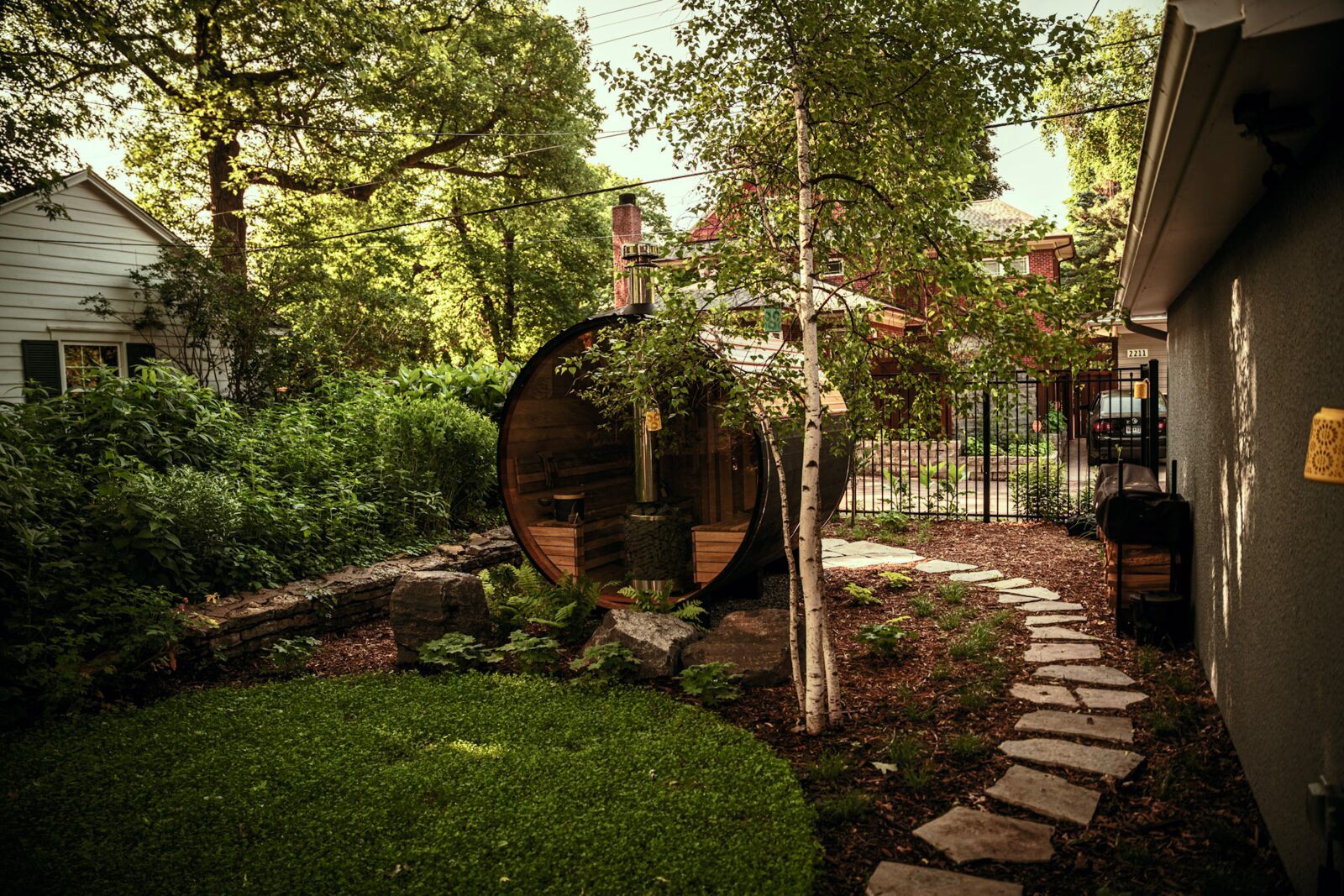
A custom-built barrel sauna set into a landscape — among trees, beside water, on a hillside — looks like it belongs there.
Between the first Google search and the day your sauna is delivered, there are dozens of decisions to make. Wood species. Heater type. Size. Site prep. This guide covers all of it, written by people who build saunas for a living and have delivered and installed them across the country.
One thing to sort out early: if a sauna ships to your door in a box or arrives on a pallet as a pile of parts, that's a signal — not of savings, but of compromised materials and no real craftsmanship behind it. The saunas in this guide are built saunas. The kind you sit in, not assemble.
Why the Shape Matters
A rectangular sauna's corners are architectural dead weight. Four 90-degree joints collect stale air, create thermal cold spots, and force the heater to work harder to reach an even temperature throughout the room. The rectangular form was optimized for framing, not for heat.
Radiant heat circulation. A barrel sauna's cylindrical interior creates a natural convection loop — heat rises, follows the curved ceiling, and descends along the walls. There are no corners trapping stale air or creating uneven hot spots. The result is an enveloping, consistent heat that surrounds you rather than blasting you from a single direction.
Room to fully relax. A properly sized barrel sauna — at minimum 8 feet in length — gives you the room to lie down, stretch out, and stay in long enough for the session to do its work. The ability to lie flat and experience full-body radiant heat is what makes a sauna session actually work. Anything shorter compromises that.
Efficiency. The curved walls eliminate dead corner space that wastes BTUs. You're heating the space you actually occupy.
Single-level seating. Rectangular saunas use two-tier bench configurations. The temperature differential between the upper and lower bench can be 20–30°F — the people who want more heat claim the upper bench, and everyone else sits in cooler conditions. On a two-tier bench, the person up top typically extends their legs onto the lower bench, effectively taking two seats. The barrel sauna's single-level bench puts every person at the same height, in the same heat, with the same experience. It also makes conversation natural — eye contact, no one craning up or down, the kind of easy back-and-forth that makes a sauna session with friends or family genuinely comfortable. The sauna is fully accessible to everyone in the room — including the elderly, anyone with a mobility limitation, anyone for whom climbing a second tier is simply not possible. That's a design choice, not an afterthought.
Drainage. The curved floor creates a natural pitch toward the drains — condensation and rinse water flow to the center without requiring a separately constructed subfloor or special floor preparation. Nomad barrels include floor drains as standard. A rectangular sauna floor is flat by nature; managing moisture properly requires the entire floor to be significantly pitched toward center or perimeter drains. This is frequently done inadequately in residential installations, which means moisture accumulates in corners, accelerating wood degradation and creating conditions for mold.
Aesthetics. A barrel sauna is a statement piece. It looks intentional in a backyard, on a deck, next to a cold plunge, or at a lakeside camp. A rectangular sauna in the same setting looks exactly like what it is: a shed with a heater in it.
Longevity. A custom-built barrel sauna from quality wood, maintained properly, can last 30 years or more. Built right, it outlasts everything else in your backyard.
The research. A prospective cohort study tracking 2,315 Finnish men over a mean follow-up period of 20.7 years found that men who used the sauna four to seven times per week had a 63% lower risk of sudden cardiac death and a 50% lower risk of fatal cardiovascular disease compared to those who used it once weekly.1 The same research group subsequently documented associations between frequent sauna use and reduced risk of stroke, dementia, and Alzheimer's disease — men bathing four to seven times weekly showed a 65–66% reduction in dementia and Alzheimer's risk compared to once-weekly users.2 A comprehensive review published in Mayo Clinic Proceedings concluded that the physiological responses to sauna heat — increased heart rate, cardiac output, and peripheral vasodilation — closely resemble those produced by moderate aerobic exercise, and that sauna bathing is associated with a range of cardiovascular and non-cardiovascular health benefits.3
The Finnish populations in these studies were not research subjects who adopted sauna bathing for health reasons. They were people who bathe in saunas because that is what Finns have done for thousands of years. The epidemiology put precise numbers to what the tradition had always practiced.
Wood Species
Wood determines how a sauna heats, how it smells, how long it lasts, and how it feels to be inside it. Most buyers focus on the visible finish. The decision that actually matters is what's going on inside the walls.
Clear Grade Western Red Cedar
The standard for a serious outdoor barrel sauna. Clear-grade western red cedar has less than one knot per 6 linear feet — and in a sauna, this matters more than aesthetics. Knots are weak points that expand and contract at different rates under the repeated thermal cycling of a sauna's heat-up and cool-down. Over time, they loosen, work their way out, and can create voids in the barrel wall. They also get genuinely hot to sit on or lean against.
Western red cedar earns its reputation through natural moisture resistance, dimensional stability, and the aromatic oils that give a quality sauna its signature scent. It handles the cycle of high heat and cold ambient air better than most available species and doesn't require chemical treatment. Cedar's heartwood contains naturally occurring compounds called thujaplicins — specifically α-, β-, and γ-thujaplicin — that inhibit the growth of wood-degrading fungi without any applied preservative.4 Research published in Wood Science and Technology confirms that thujaplicin concentration correlates directly with decay resistance, and that higher concentrations are found in older-growth heartwood.5 This is why clear-grade cedar from mature trees outperforms younger, lower-grade material not just aesthetically, but structurally — the chemistry is different.
Most kit manufacturers offer clear cedar as a premium upgrade. Their default option is rustic cedar — the same species, but with knots throughout. The price difference is real. So is the performance difference over a 10- or 20-year horizon.
Stave thickness: why the number on the label isn't the number you're buying. When you see lumber sold as "2-inch" at a lumberyard, the actual milled thickness is 1.5 inches. This is the lumber industry's nominal sizing convention — the name reflects the rough-cut dimension before milling, not the finished dimension you actually get. A "2-inch" board is 1.5 inches true. A "1½-inch" board is actually closer to 1-3/8 inches true.
Stave thickness directly determines two things: thermal mass and structural integrity.
Thicker staves hold more heat energy. They take longer to saturate during heat-up, but once at temperature they radiate steadily and evenly rather than spiking and dropping. They're also what gives the barrel its rigidity and its ability to weather decades of thermal cycling without warping, gapping, or structural degradation.
The minimum stave thickness for a quality outdoor barrel sauna is 1.5 inches true — that's 2-inch nominal lumber at the lumberyard. Some kit manufacturers advertise 1-3/8 inch staves as their standard. That's below the threshold for long-term structural performance in an outdoor installation. Get a specific true measurement — not the nominal label — before you compare prices.
Western Hemlock
Denser and smoother than cedar, with a more neutral scent. A preference among Scandinavian-tradition builders who want the heat and steam to stand alone without aromatic interference. Holds heat well. Requires more careful placement than cedar — good airflow and a covered or sheltered location are preferred. The denser surface can also run quite hot against bare skin during longer sessions, worth knowing before you choose it.
Best for: Indoor or well-sheltered outdoor installations. Users who prefer a scent-neutral experience.
Yakisugi
Yakisugi is a traditional Japanese method of charring cedar — not a finish applied to it, but a transformation of the wood itself. The charring process densifies the outer surface, closes the grain, and creates a natural barrier against moisture, UV, insects, and decay. No stain, no sealer, no annual treatment. Once charred and finished, a yakisugi exterior requires no ongoing maintenance — the wood protects itself.
The aesthetic is distinct: deep, dark, textured, with a grain that reads differently in different light. In a natural setting it doesn't call attention to itself the way a stained or oiled exterior does. It recedes into the landscape. For buyers who want a sauna that looks like it's always been there, it's worth understanding what yakisugi actually is — and why the process matters more than the look.
A note on terminology: Yakisugi is the correct Japanese term for this technique. Shou Sugi Ban is a mistranslation that became common in Western markets. Both terms derive from the same kanji characters (焦杉板), but Shou Sugi Ban mixes Chinese and Japanese readings — "Shou" is the Chinese pronunciation of 焦, "Sugi" is the Japanese reading of 杉, and "Ban" is Mandarin for 板. A Japanese speaker wouldn't recognize "Shou Sugi Ban." The correct reading is Yakisugi (or Yakisugita). At Nomad, we use the proper term because we practice the authentic technique — and using the right name is part of respecting the craft.
Best for: Outdoor installations. Anyone who wants a low-maintenance exterior with a finish that doesn't fade, peel, or need refreshing.
The Wood Inside the Walls
Most sauna manufacturers — and virtually all kit producers — use western red cedar on the visible interior surfaces. What they don't advertise is what they use for framing, structural members, and the wood hidden inside the walls.
Cheap framing lumber in a sauna environment molds, rots, and fails structurally over time. The interior of a barrel sauna reaches sustained high heat and humidity every session. Subpar wood in the hidden structure degrades from the inside out, compromising the barrel's integrity years before the exterior shows any sign of it. When evaluating a builder, ask specifically what wood is used throughout — not just on the benches and interior finish.
Thermally Modified Wood
Thermally modified woods — heat-treated to improve moisture resistance and dimensional stability — are sometimes marketed as a premium alternative to cedar. The evidence on long-term performance in sauna environments is still inconclusive. A 2025 state-of-the-art review in Wood Material Science & Engineering identified moisture and extreme temperature cycling as the primary degradation vectors for CLT and thermally modified wood in building applications6 — precisely the conditions a sauna produces with every session, every day, for decades. Long-term field data for thermally modified species specifically in sauna hot-room applications has not been established.
Certain brands stamp and paint thermally modified staves to mimic the look of yakisugi — the traditional Japanese charred cedar finish — without the actual process, the authentic material, or any of the genuine benefits. It's a cosmetic imitation that fades in UV exposure and offers nothing of what real yakisugi delivers. Worth knowing before you pay a premium for what amounts to a paint job. Thermally modified wood also carries a noticeable odor and lacks the natural aromatic quality of cedar — which is most of what makes a cedar sauna smell like a cedar sauna. "Modified" is not the same as "better."
Heater Types: Electric or Wood-Fired
Electric Heaters
Electric heaters require a dedicated 240V circuit and no chimney — the straightforward path for most backyard installations.
For barrel saunas 8 feet and larger, most residential installations use a 9kW unit or higher, sized for the interior volume. The specification most buyers overlook: rock coverage. A quality sauna heater should have stones surrounding the heating element all the way to the ground, at floor level. That's what produces löyly.
Löyly — the steam and heat produced when water meets the stones — is the defining sensory experience of a sauna session. For it to work properly, the stones need full surface area, sufficient mass, and placement low enough that the steam rises through the entire height of the room. Stones at floor level produce the most even, enveloping heat distribution. That's what you're looking for in a heater.
Heaters with minimal rock coverage and a lot of exposed steel — common on kit saunas — produce direct, dry heat rather than the soft radiant heat of a properly stoned heater. They also can't hold water properly. The stones are the difference between a hot room and a real sauna.
Heat-up time: A properly sized electric heater in a well-built 8-foot barrel sauna reaches working temperature in approximately 75–90 minutes. That's longer than many heaters on the market, and the reason matters. A stone-rich heater is bringing hundreds of pounds of rock up to temperature, not just the air. That mass is what produces the soft, enveloping heat of a proper session and holds it steady for hours without spiking or dropping. A heater that reaches temperature in 20 minutes does so because there's minimal stone to heat — and it drops just as fast when you throw water on it. The studies on sauna health outcomes used sessions averaging 15–20 minutes at temperatures around 174°F (79°C), repeated four to seven times per week.1 Holding that temperature consistently through a full session is what the physiology requires. A properly stoned heater in a well-built barrel is built for exactly that.
Pros: Precise temperature control, app-enabled preheat on many modern units, low maintenance.
Cons: Requires 240V dedicated circuit, ongoing electricity cost.
Wood-Fired Heaters
A wood-burning stove produces heat that's genuinely different — softer, more radiant, with natural humidity variation as the fire builds. For many sauna traditionalists, it's the defining experience. Setup requires a proper chimney penetration through the barrel and spark arrestor compliance depending on local code.
Wood-fired and electric heaters reach working temperature in comparable time — 75–90 minutes. With wood, the quality of the fire matters. A well-built fire with dry hardwood brings a properly stoned heater to temperature efficiently; it's a skill that comes quickly and becomes part of the ritual for people who prefer this method.
Pros: Off-grid capable, no electrical hookup required, authentic heat character. The fire also brings its own presence — the sound of crackling wood and the visual of an open flame give a wood-fired session a fireplace-like quality that electric can't replicate.
Cons: Requires chimney installation, regular ash removal, some municipalities have burn restrictions.
Sizing Guide: How Big Does Your Sauna Need to Be?
The short answer: 8 feet minimum, without exception.
A barrel shorter than 8 feet puts occupants too close to the stove for full-body radiant heat. You get direct heat, not the enveloping experience that defines a quality session. The 8-foot length also provides what matters most: enough room to lie down.
You might not think lying down in a sauna matters right now. You will eventually. A sauna is a lifelong practice — not a piece of fitness equipment you outgrow, but a ritual that deepens over years and decades. Your future self, after a long day or a hard week, will want to stretch out fully and let the heat do its work. Buy for that person, not just for today.
| Size | Comfortable Capacity |
|---|---|
| 8 ft | 4–6 people |
| 10 ft | 6–8 people |
| 12 ft | 8–10 people |
| Extended (14 ft+) | 10+ people |
All configurations use single-level bench seating. This is deliberate. In a rectangular sauna, two-tier benches exist because the heat stratifies sharply — it's significantly hotter at the top and significantly cooler at the bottom, and the only way to get a proper sauna experience is to climb. In a barrel sauna, the cylindrical convection keeps heat more consistent throughout the room. There's no performance advantage to a second tier — only the exclusion it creates.
The barrel gives you both: even heat and room to stretch out, without climbing or compromising.
Size up for the sessions you want to have, not the sessions you have today. Longer barrels simply provide more bench room per person without changing the heat experience.
Most people reach this point with a specific property in mind. If you want to talk through what makes sense for your site — size, configuration, foundation — we're easy to reach. Most of those conversations take about 20 minutes and answer everything.
Windows
A window changes the inside of a sauna more than almost any other decision. Natural light, a view, a connection to what's outside — it's the difference between a box you sit in and a room you actually want to be in.
The standard in a Nomad sauna is ½-inch tempered glass — not a small porthole, not 3/8-inch safety glass sold as an upgrade by kit manufacturers. At ½-inch thickness, tempered glass contributes genuine thermal mass and structural integrity to the end wall — it holds heat, holds its shape under thermal stress, and lasts. Full ½-inch tempered glass opens the end of the barrel completely to natural light and view in a way thinner panels simply don't achieve.
Positioning matters. If the sauna faces a cold plunge, a pool, or a natural body of water, the window becomes functional — watching the water while you heat, then stepping out into it, is the full contrast experience. For families, a window facing the pool means you can keep an eye on kids outside without leaving the session. That's a real consideration worth thinking through before you decide where the sauna sits.
Kit vs. Custom-Built
The upfront price difference is real. The full-cost difference is not what it first appears.
What a kit actually involves
A kit sauna ships in pieces. You assemble it. The assembly process, documented in manufacturers' own installation manuals, involves permanently fastening staves to the cradle base with 2-inch screws (one per board), then screwing every second or third stave into the front and back end panels to lock them in place.
Wood expands when it heats and contracts when it cools. Every sauna session is a thermal cycle. Staves that are permanently fastened with screws and nails cannot move freely through this expansion and contraction — instead, the stress accumulates in the wood itself. The result, over time, is splintering and cracking at the fastener points. The same manuals acknowledge this reality by including instructions for inserting "filler staves" as gaps open from shrinkage.
The final stave in the assembly requires custom cutting to fit the remaining gap — a precise cut on a curved piece of wood that, done improperly, creates a permanent gap in the barrel wall.
What you end up with is not a tight permanent barrel. It's an assembly you maintain — tape, filler staves, incremental fixes — as the wood moves.
The specs side by side
| Specification | Standard Kit Build | Custom Built |
|---|---|---|
| Stave thickness | .75"–1-3/8" | 1.5" true — varies by builder |
| Default wood | Rustic cedar (knots throughout) | Clear grade cedar |
| Window glass | 1/4"–3/8" — optional add-on | Varies by builder (Nomad: ½" tempered, standard) |
| Assembly | Buyer-assembled, screws into staves | Shop-built (Nomad: delivered and installed complete) |
| Stave fastening | Permanently screwed | Varies by builder (Nomad: freely moving, shop-fitted) |
| Floor drains | Varies — basic gap only | Varies — rarely standard (Nomad: standard) |
| Heat-up time | 30–45 min (minimal stone) | 45–75 min (Nomad: 75–90 min, full stone mass) |
| Price range | $3,000–$8,000 (materials only, before heater, delivery, electrical) | $12,000–$80,000+ complete |
| Realistic lifespan | 3–12 years | 10–30+ years |
The math over time
A fully installed kit sauna — materials, heater, delivery, and electrical — typically runs $8,000–$12,000. At a 10-year lifespan, that's $800–$1,200 per year. A $30,000 custom sauna at 30 years is $1,000 per year — already comparable, before you account for the cost of replacing the kit, the time spent assembling it, and the decade of compromised experience in between. Buy the kit twice over 20 years and you've spent more than the custom sauna cost, for two worse saunas.
The kit doesn't save money over the ownership horizon. It defers cost in exchange for a worse experience throughout.
If budget is the driving constraint, a kit sauna from a reputable supplier is a real sauna. Know what you're getting. But if you're comparing prices honestly — full installed cost over realistic lifespan — the math doesn't favor the kit.
Rectangular Saunas
The rectangular sauna is the accepted standard by default, not by evidence. It was the easiest shape to frame and insulate with conventional construction materials, and it arrived first. That's the whole explanation.
Some rectangular sauna builders have invested heavily in making the rectangular sauna feel premium — premium pricing, beautiful photography, engineered structural materials. At $50,000 to $70,000 for an insulated rectangular room, you're paying for craftsmanship, materials, and a strong brand. What you don't change is the shape's fundamental thermal limitations: the corners, the stratified heat, the two-tier hierarchy built into the bench configuration.
There's also a drainage problem inherent to the form. A rectangular sauna floor has no natural drainage path. Moisture — from steam, from löyly, from sweat, from rinse water — accumulates flat against the floor and sits in corners. Managing this properly requires the entire floor to be dramatically pitched toward a center drain or perimeter drains, correctly installed and waterproofed. Many residential rectangular saunas don't do this adequately. The result is chronic moisture, accelerated wood rot, and mold inside a structure people are specifically using for their health.
A custom-built barrel sauna doesn't cost more than a well-built rectangular sauna to produce what it was designed for. It costs less per degree of heat quality, because the shape is doing work that the rectangular form has to engineer around. That's not a competitive claim — it's geometry.
There's a materials question worth asking directly. Rectangular saunas rely on insulation inside the wall assembly. Most conventional insulation — fiberglass batts, foam board, spray foam — and the vapor barriers, adhesives, and gaskets that go with them, were not designed for the sustained heat and humidity of a sauna environment. Fiberglass insulation is bonded with phenol-formaldehyde resins. Foam insulation — XPS, EPS, polyurethane — begins to degrade at temperatures that a sauna reaches in normal operation, releasing styrene. Standard vapor barriers leach plasticizer VOCs under heat. That's not a theoretical risk or a fringe concern. It's basic material chemistry happening in a sealed room you're specifically using for your health. It's a real question worth asking any rectangular sauna builder before you buy: what exactly is inside your walls, and what happens to it at 180°F with moisture in the air?
Site Preparation
Gravel bed: 4–6 inches of compacted crushed gravel is the most common and cost-effective foundation option. Good drainage, easy to level, no concrete work required.
Concrete pad: More permanent, excellent for areas with frost heave. Standard 4-inch slab with proper drainage slope.
Deck or platform: Verify load capacity before delivery. An 8-foot barrel sauna fully loaded exceeds 2,000 lbs. Confirm your structure can handle it.
Electrical: For an electric heater, plan for a dedicated 240V circuit — typically 40–60 amps depending on heater size. A weatherproof subpanel or conduit run from the main panel is standard. Get it permitted and inspected. Typically $300–$600 for an electrician depending on distance from the panel.
Clearances: Allow 18–24 inches on the sides and rear for airflow and access. Check local setback requirements from property lines — most residential zones require 5–10 feet from the fence line for accessory structures.
Water access: Not structural, but a nearby hose bib is a quality-of-life upgrade that extends the wood's life through easier post-session rinsing.
Delivery and Installation
A Nomad barrel sauna doesn't arrive in a box. It arrives assembled — a complete, finished unit, built in a shop and shipped to your property.
Nomad coordinates the full delivery and installation. You'll receive a delivery window, and you'll need to be present with a clear path from the street to the installation site. Once it's positioned on your foundation, a Nomad representative walks you through the heater setup and the sauna itself — how it heats, what to expect from the first few sessions, and how to care for it.
Maintenance
A custom-built barrel sauna is low-maintenance.
Interior: Don't stain or seal the interior. The wood needs to breathe and naturally patina with use. Wipe down benches after sessions. Warm water and a natural-bristle brush is all that's needed for cleaning. Harsh chemicals degrade the wood and introduce odors that accumulate in a closed, heated space.
Exterior: Treat the exterior annually with a UV-resistant wood oil appropriate for cedar. This is the primary maintenance task that determines lifespan. The exterior faces weather constantly; protect it and the wood will reward you for decades. If your sauna has a yakisugi exterior, no treatment is needed — the charring process is self-protecting and requires no ongoing maintenance.
Door: A well-fitted sauna door doesn't require a gasket. A slight gap is actually beneficial — it allows for passive airflow, which improves the sauna environment and prevents the stagnant, overly humid air that a fully airtight door can produce. Gaskets wear out, compress over time, and become a maintenance item a properly constructed door simply doesn't need. When evaluating a build, ask how the door is fitted — and whether it depends on a component that degrades.
Heater: All heaters — electric and wood-fired — should have their stones removed annually, inspected, and restacked. This is a best practice that's easy to skip and easy to regret: stones shift over time, and proper stacking directly affects heat distribution and löyly quality. Electric heaters otherwise require almost no maintenance. Wood-fired stoves also need regular ash removal and an annual chimney inspection.
On kit longevity: No amount of maintenance overcomes the limitations of thin staves, knotted framing lumber, and screwed-in staves that crack along fastener points over time. The degradation in a kit sauna is structural, not cosmetic. Maintenance extends the timeline; it doesn't change the outcome.
10 Questions to Ask Before You Buy
1. What wood is used throughout — species, grade, and true stave thickness — including framing and hidden structure, not just the visible finish?
Clear-grade cedar on the interior surfaces is the baseline. Ask what's behind the walls. For stave thickness, get the true measurement, not the nominal label — the answer should be 1.5 inches true (2-inch nominal) or greater for an outdoor installation. Vague answers on either question are informative.
2. What's included in the price — fully itemized?
Heater, door, benches, windows, delivery, and installation should all be accounted for. Get a complete number before comparing quotes across builders.
3. Where is it built, and how is it built?
Know whether you're buying a shop-built unit or assembling a kit. Ask about the construction method, not just the materials.
4. What heater do you use, and how much stone coverage does it have?
Stones surrounding the heating element at foot level produce the best heat distribution and proper löyly. Ask for specifics.
5. What is the window glass thickness, and is it standard or an add-on?
½-inch tempered glass should be standard. 3/8-inch is below the mark, and anything sold as an upgrade package is worth scrutinizing.
6. How is it shipped, and who is responsible for damage in transit?
Understand the freight process, your liability on delivery day, and what the claims process looks like if something arrives damaged.
7. What's the warranty, and what does it cover?
Look for a structural warranty of at least one year and clear language on what voids coverage.
8. What does the delivery and installation experience look like?
Will someone be on-site? Will you receive a walkthrough of the sauna, the heater, and the care requirements? Or does it drop off the truck and that's the end of the relationship?
9. What does the long-term relationship with this builder look like?
Parts availability, support for questions years after the sale, and the ability to reach a real person are worth asking about before you buy — not after.
10. What materials are used inside the structure — insulation, vapor barriers, gaskets, and windows?
This question matters more than most buyers realize — and it's one most buyers never think to ask.
Any material inside a sauna is exposed to sustained high heat and humidity every single session. This is not a normal building environment. Materials rated for standard residential construction were not tested at 170–190°F with moisture.
The material that shows up most often in lower-cost builds is pink foam board — extruded polystyrene (XPS), the rigid insulation panels you'll recognize by their bright pink or salmon color. It is cheap, easy to cut, and fast to install. It is the wrong material for a sauna. XPS begins releasing styrene — a compound the National Toxicology Program classifies as reasonably anticipated to be a human carcinogen — at temperatures well within normal sauna operating range. A vapor barrier does not stop this. Styrene permeates standard polyethylene vapor barriers over time, and sustained heat accelerates that migration. The installation process makes it worse: securing a vapor barrier to framing requires fasteners — staples or nails through the material. Each penetration is a void. Tape over the surface doesn't restore barrier integrity. A vapor barrier that's been stapled into a sauna wall assembly is not a complete barrier by definition, even if it's a material rated for the application. If a builder used pink foam board in your wall assembly, you are breathing what it releases every session, vapor barrier or not.
Beyond XPS: fiberglass insulation releases formaldehyde from its phenol-formaldehyde binder resins under sustained heat. Polyurethane spray foam releases isocyanates and other VOCs. Standard vapor barriers leach plasticizer VOCs under heat.
Saunas are an unregulated product category. There is no building code inspection for sauna interiors, no material certification requirement, no third party verifying that what's inside your wall is safe at operating temperature. Some builders use these materials because they don't know better. Some use them because they cut cost and assembly time. The buyer has no visibility into the wall assembly without asking — and most never do.
This isn't a hypothetical. There are saunas in use right now with pink foam board inside the walls, built by contractors who didn't think through the chemistry. The people using them have no idea.
Ask for a complete materials list: insulation type, vapor barrier specification, adhesives, gaskets, window material. Get it in writing. If a builder can't or won't provide it, that's your answer.
Ready to Talk?
Every Nomad sauna is built by hand in Hudson, WI and delivered nationwide. If you're at the point where you have a site in mind and want to talk through the details — size, configuration, foundation, timeline — reach out. We build these for a living and most questions get answered in one conversation.
References
- Laukkanen, T. et al. "Association between sauna bathing and fatal cardiovascular and all-cause mortality events." JAMA Internal Medicine 175, no. 4 (2015): 542–548. PubMed 25705824
- Laukkanen, J.A. et al. "Sauna bathing is associated with reduced cardiovascular mortality and improves risk prediction in men and women: a prospective cohort study." BMC Medicine 16, no. 219 (2018). PMC6262976. Dementia and Alzheimer's risk reduction figures from the same research group's analyses of the Kuopio Ischaemic Heart Disease Risk Factor cohort.
- Laukkanen, J.A., Laukkanen, T., and Kunutsor, S.K. "Cardiovascular and Other Health Benefits of Sauna Bathing: A Review of the Evidence." Mayo Clinic Proceedings 93, no. 8 (2018): 1111–1121. mayoclinicproceedings.org
- Youn, C.K. et al. "The Antimicrobial Properties of Cedar Leaf (Thuja plicata) Oil; A Safe and Efficient Decontamination Agent for Buildings." PLOS ONE 7, no. 1 (2012): e30561. PMC3290980
- Stirling, R. and Vossberg, C. "Western red cedar extractives associated with durability in ground contact." Wood Science and Technology 46 (2012): 997–1009. Springer
- Nore, I. et al. "Cross-laminated timber: a state-of-the-art review of moisture, fire, acoustics, and energy-related aspects." Wood Material Science & Engineering (2025). tandfonline.com
Tags: barrel sauna, cedar, custom, buying guide, kit vs custom, yakisugi, sauna heater
Related saunas
- Custom barrel saunas, built to order — Backyard, mobile, floating, and commercial builds. No kits.
- Barrel sauna buyer's guide — Cost, sizing, and kit vs. custom — what to ask any builder.
- Request a backyard design consultation — Tell us about your property. We'll design a sauna around it.