Education 6 min read
Heater Stone Coverage: The Underrated Spec
By Nomad Sauna
Heater Stone Coverage: The Underrated Spec
Most buyers shop a sauna heater by kilowatts. They calculate room volume, match it to a kW rating, and stop there. Stone capacity sits lower on the spec sheet, measured in weight, and usually gets treated as a secondary detail.
It isn't. Stone coverage determines the feeling of the heat you sit in. It determines how well your löyly responds when you throw water. And for electric heaters specifically, it is the difference between a harsh, coil-heated room and a soft, radiant one.
What Stone Coverage Actually Means
Stone coverage refers to the quantity of sauna stones the heater is designed to hold, expressed in weight. More stones means more thermal mass inside the heater. That mass does two things.
First, it absorbs and moderates heat. The heater's elements — whether electric coils or a wood fire — transfer energy into the stones. The stones store that energy and release it slowly and evenly into the room. A heater with low stone capacity has less buffer between the element and the air. The room heats unevenly, temperature swings between cycles, and the heat feels sharp rather than enveloping.
Second, it holds steam. When water contacts hot stones, it flash-vaporizes into steam. That steam, the löyly, is the central act of a proper sauna session. A heater with substantial stone mass vaporizes water into a full cloud of soft steam that spreads across the room. A heater with minimal stone mass returns a thinner, faster vapor that dissipates before it settles. The stones need to have enough stored heat to actually absorb the water without dropping temperature dramatically.
Why Element Coverage Matters As Much As Weight
Every heater spec sheet lists stone capacity. What it often does not show is how well the stones cover the heating elements.
In an electric heater, the coils radiate heat directly. When stones do not fully surround them, the coils heat the air near them rather than the stone mass. The result: a hot, dry room where coil-generated heat hits exposed skin more aggressively. It feels sharp and thin.
When coils are fully surrounded by stones, the heat pathway changes. Energy moves from coil into stone, from stone into air, and from stone into steam. The room heats differently. More ambient. The surface temperature of the walls, the bench, and the air all converge rather than the heat coming from one visible source.
Stone depth matters as much as total weight. A heater loaded shallowly around the edges is not equivalent to one where the stones rise well above and around the elements on all sides.
Floor-Standing vs. Wall-Mounted
Most kit-sauna heaters are wall-mounted: compact units that bolt to the room wall at knee height, with a shallow stone basket on top. They are space-efficient and easy to install, and they hold a fraction of the stone volume a floor-standing heater does.
The wall-mounted format also creates a practical problem: the stones sit at knee height, below the bench. Throwing water accurately onto a small basket from a seated position above it, in a hot room, requires a specific angle. The ladle works against the geometry.
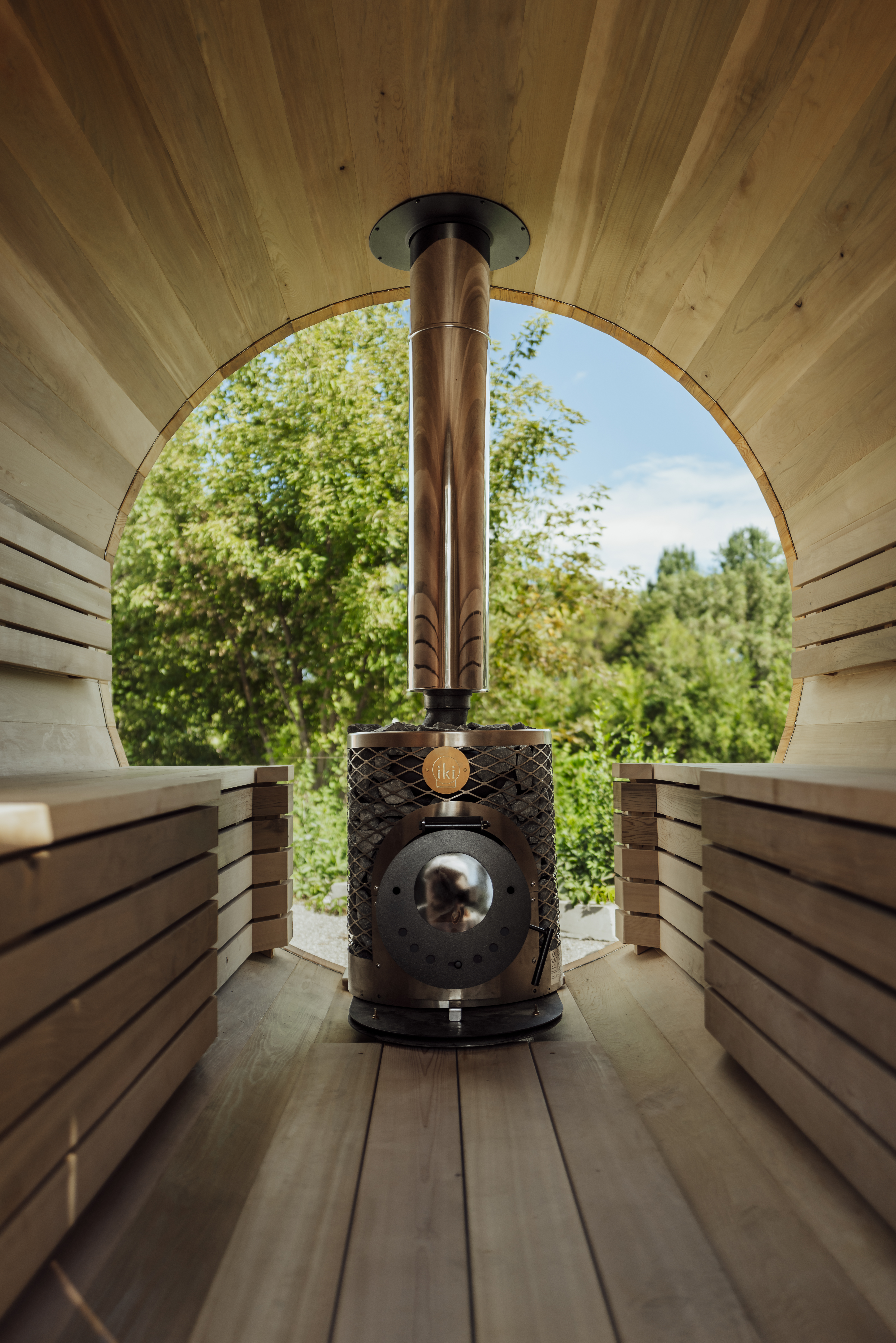
Nomad uses floor-standing heaters across the residential barrel lineup. The heater sits on the floor with stones extending down to floor level, not mounted above it. Stone mass starts at the base. This changes both the thermal profile of the room (heat radiates from a lower origin point and rises more evenly through the space) and how the löyly session works practically (the stone surface is accessible, broad, and at a natural pour angle from the bench).
Sizing Above the Minimum
The standard formula for electric heater sizing is roughly 1 kW per cubic meter of room volume, adjusted upward for outdoor-installed saunas exposed to cold. Stone capacity doesn't scale exactly with kW and should be checked independently.
For Nomad's three residential barrel sizes:
Each heater is intentionally sized above the minimum kW threshold for its room volume. An undersized heater running continuously at maximum load to reach temperature puts sustained strain on the heating coils. Coil failure is almost always a function of prolonged full-power operation, not peak output. A heater with overhead capacity runs at a lower percentage of its maximum to hit the same target temperature, which extends element life significantly.
The secondary benefit: a heater with genuine headroom heats faster. That difference adds up across a winter of regular use.
The Homecraft lineup used in Nomad electric builds is UL-listed with in-house controllers. Wood-fired builds use the IKI Mini/Original, which operates on a different thermal logic: a combustion chamber heats a much larger, denser stone mass. Heat-up takes longer, but temperature stability once reached is exceptional, and the löyly from a wood-fired stone mass has a quality that electric cannot fully replicate.
Evaluating a Heater Spec Sheet
When comparing heaters:
Stone capacity in weight. Find this number. If the manufacturer doesn't publish it, treat that as a signal.
Element coverage. How deep do the stones sit relative to the coils? Cross-section diagrams show this better than spec sheets. If you can only find a photo of the top of the heater, ask for the internal view.
Heater geometry. Does the stone mass begin at the floor or at a wall bracket? Where the stones start in the room changes what the heat does.
kW relative to room volume. Size for the room, then add margin for outdoor exposure and for the thermal load of a cold start in winter.
Electrical circuit. Most quality heaters require a dedicated 240V circuit. Verify amperage before ordering — 50A and 70A are different wiring jobs.
A heater that cuts stone capacity to hit a lower price point will still heat a room. The room will just feel different, and the coils will age differently.
The Stones Themselves
The heater is only half the equation. The stones are a variable too.
Good sauna stones are dense, non-porous, and crack-resistant under rapid thermal cycling. Raakku (Finnish olivine diabase) is the traditional choice. Dense volcanic basalt is a common and reliable alternative. Sedimentary stones, river rocks, and general garden aggregate are not sauna stones. They will crack, fracture, or spall under temperature swings, and loose fragments can damage elements or produce unpredictable steam.
Replace stones every three to five years under regular use. Over time, even quality stones absorb minerals from poured water, develop surface chips, and lose the clean thermal cycling they had when new. A heater maintained with fresh, quality stones holds its löyly character. One running on old, fragmented stones does not.
Frequently Asked Questions
What is stone coverage in a sauna heater?
Stone coverage refers to how much sauna stones the heater is designed to hold, and how fully those stones surround the heating elements. More stone mass produces more stable heat and better steam quality when water is added.
Does higher kW mean better löyly?
Not directly. Kilowatt rating determines how quickly a heater reaches temperature and what room volume it can sustain. Stone capacity determines the character and quality of the steam. A 10 kW heater with high stone coverage will typically produce better löyly than a 12 kW heater with minimal coverage.
How often should sauna stones be replaced?
Every three to five years under regular use. Signs it is time: visible cracking or spalling on the stone surfaces, cloudy or mineral-heavy steam, or longer heat-up times from a heater that previously ran faster.
Why does Nomad use floor-standing heaters instead of wall-mounted?
Floor-standing heaters hold more stone volume, provide better element coverage, and radiate heat from a lower starting point in the room. They also make the stone surface more accessible for throwing water. Wall-mounted heaters trade those qualities for space efficiency, which is the right trade in some installations — but not in a barrel sauna built around the löyly session.
To talk through heater configuration for your specific build, book a 30-minute consultation or request a quote.
Related saunas
- Custom backyard barrel saunas — Delivered fully assembled, ready to fire the first night.
- Custom barrel saunas, built to order — Backyard, mobile, floating, and commercial builds. No kits.