Comparison 14 min read
Authentic Yakisugi vs. Painted Imitation
By Nomad Sauna
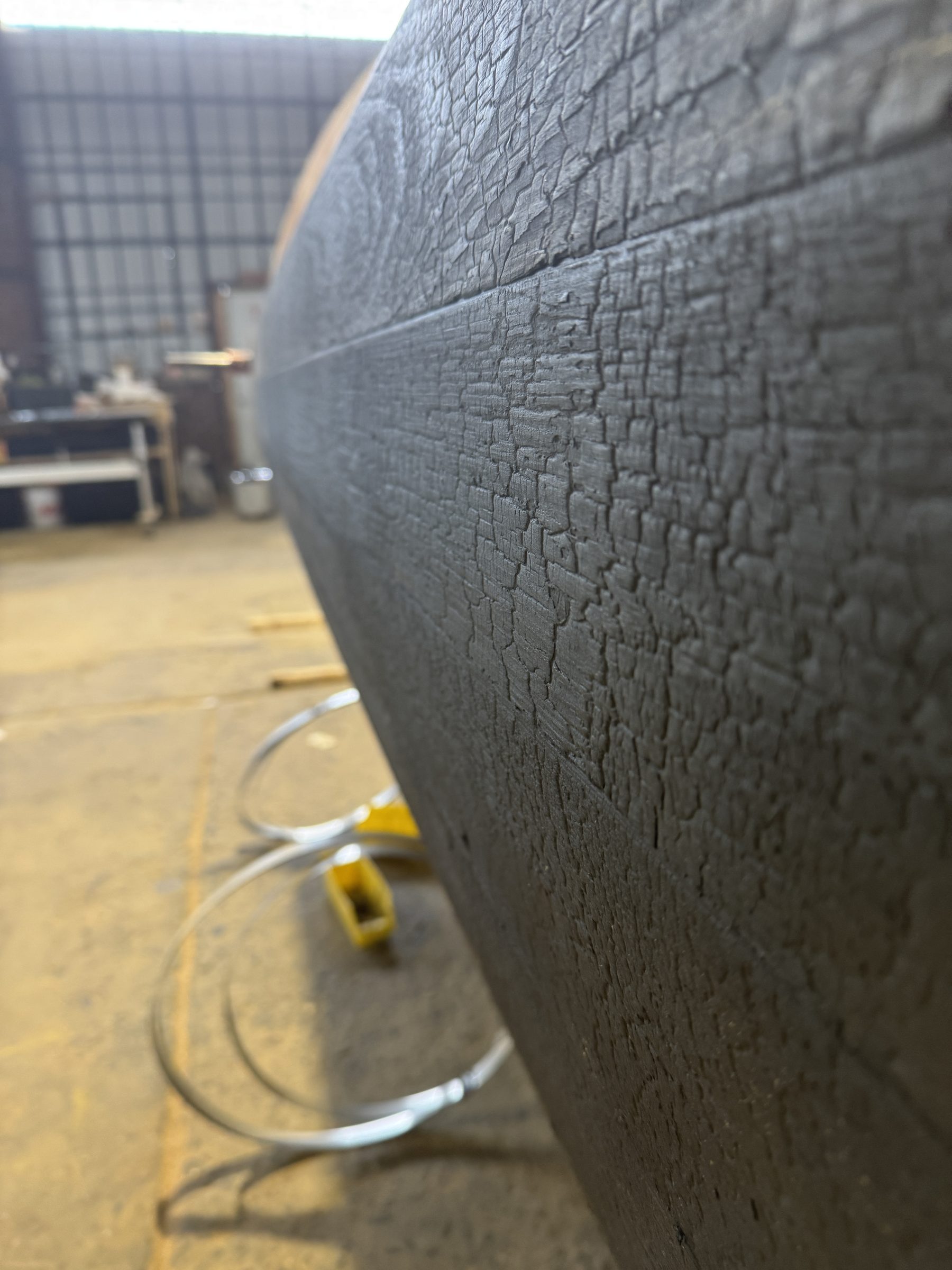
Search shou sugi ban and you will find a lot of black wood. Some of it was burned. A lot of it was painted. From ten feet away, in a photo or a showroom, the two look alike. Ten years later they do not.
Here is the short answer. Authentic Yakisugi is wood whose surface has been charred by fire, and the char is the finish. Painted imitation is wood, often a cheaper species, that has been coated black or lightly scorched and then covered, so the color sits on top of the wood instead of being made from it. If you are paying for hand-charred wood, you are paying for the first one. The rest of this post is how to tell them apart before you buy.
Yakisugi or shou sugi ban: what the name means
Yakisugi (焼杉) means "burnt cedar." It is a traditional Japanese method of preserving wood by charring the surface. "Shou sugi ban" uses the same characters with a different reading, and ban means plank. Wikipedia's entry on the technique lays out the relationship.
In the American market, shou sugi ban became the name everyone searches for, and it ended up standing in for the technique itself. We use Yakisugi because it names the method. A plank is a product. A technique is something you can do well or badly, and that is the whole subject of this post. You will still see us acknowledge shou sugi ban, because it is how most people find the topic.
How authentic Yakisugi is made
The traditional method is simple and a little theatrical. Three boards are bound together into a long triangular chimney. A fire is lit at the base. The chimney draws like a flue, pulling flame up the inside faces of all three boards at once and burning them evenly. When the char is deep enough, the chimney is opened, the boards are cooled, and the loose char is brushed away. What is left is a blackened surface made of the wood's own carbon.
That sequence matters because every step is physical. Fire does the work. Nothing is added.
At Nomad, the same principle runs through a different process built for barrel staves. Each stave is individually charred by hand with an open flame in our Hudson, Wisconsin workshop. The flame reveals the grain of every piece, and the staves are then assembled so the pattern runs across the full barrel. The result is a matte black exterior where the color is the wood itself. There is no paint, stain, or sealer on top, and nothing to reapply.
Where the technique comes from, and what it is for
Yakisugi is a Japanese preservation method, and the logic behind it is old and practical: wood that has been charred resists what destroys untreated wood outdoors. According to the Wikipedia entry, carbonizing the surface changes the cell structure so the wood takes on less moisture, and the char is also credited with protection against insects, fungi, and mold.
Architects noticed. Terunobu Fujimori built the Yakisugi House in 2009, and Kengo Kuma has used charred wood in projects including the Yakisugi Forest in 2022. Even the Western story has a footnote: a 2025 study reads a note in Leonardo da Vinci's Madrid Codex II as describing surface charring of debarked timber, though its authors do not claim a line of descent from Renaissance practice to the Japanese tradition. The takeaway is modest and useful. People have been noticing for a long time that fire can protect wood.
On a sauna the job is narrower and tougher. The exterior has to take sun, snow, rain, and heat cycling, year after year, without a coating to maintain. That is the standard worth holding any "charred" product to.
What painted imitation looks like
Imitation tends to fall into four groups. All of them aim for the same photograph.
Coated wood. Any board, often a cheaper species, with a solid black stain or paint. No fire involved. Nakamoto Forestry, a charred-wood supplier, describes the pattern: a lower-cost species coated with a solid black stain, where the opaque color hides the quality of the wood underneath. Treat that as one supplier's view, but it matches what the market looks like.
Torch and coat. A light surface scorch for texture, then stain or sealer over the top. The wood was near a flame, but the finish is the coating.
Planed and stained. Some folks run boards through a planer, or mill a texture into the surface another way, to get the textured look of char, then stain the wood black. The texture is cut into the wood instead of made by fire, and the color is a stain. Cut into one of those boards and you find pale wood.
Stamped or embossed. Texture pressed into the surface to mimic charred grain, with color applied afterward. It looks like char. It is not char.
Notice what is missing from the list: depth. Authentic Yakisugi is a transformation of the surface. Imitation is a layer on the surface. Those behave differently once the wood starts to move.
Language that gives imitation away
Product copy often tells you before the product does. Watch for words that describe appearance instead of process:
- "Charred look," "burnt wood effect," or "shou sugi ban style." Each describes how it looks, not how it was made.
- "Pre-finished" or "factory finished" with no mention of fire.
- "Black cedar" on a product that is a black stain over any species.
- A process described without a flame, a species, or a depth.
Sellers of authentic charred wood name the method: open flame, hand-charred, cedar. If the page cannot say, ask. Not every imitator is being dishonest, and plenty of people sell a black finish openly as a look. The problem starts when the look and the real thing are sold under the same name.
Side by side
Several of those rows are the same point restated: char is part of the wood, and paint is a skin on it. Cedar swells and shrinks as it takes on and sheds moisture, and it moves again with every heat cycle. A coating has to flex with that movement indefinitely. Char just moves with the board.
What imitation costs over time
The expense of a coated finish does not show up on the invoice. It shows up later. In the first season, coated and charred wood can look close enough that the difference feels academic. Then the wood goes through freeze-thaw and heat cycles, and the edges of a coating are where the finish starts to give. The fix is the same every time: sand, recoat, repeat.
On flat siding that is a weekend with a ladder. On a sauna barrel, with curved staves, compression bands, and a glass end cap, it is a harder, more awkward job, and one you inherit for as long as you own it. A charred surface, once it is done, is done. The higher price of real char is paying once for work a coating asks you to repeat.
Six questions to ask before you buy
Whether you are buying a sauna, siding, or a fence, these are the questions that sort real from imitation in about five minutes.
- What species is it? Authentic charred wood starts with cedar or cypress. If the seller cannot or will not say, assume it is not.
- Was it burned, and how? "Torched" is not the same as "charred." Ask whether each board is burned by hand or machine, and how deep the char goes.
- Is there a coating on top of the char? A clear oil finish to show off the wood is one thing. A solid black stain over the surface is a way to hide lesser wood and fake the look.
- Are all the faces covered? Ends, edges, and the back of a board matter on exterior work, because moisture finds them. Ask whether those are charred as well.
- Can I see a cut or scratched sample? Break the surface. Char leaves more char and wood. A coating leaves a pale line.
- What does it look like after several years? Ask for photos of installed work that has been outside, not a studio shot.
If a seller answers all six cleanly, you are probably in good hands. If the answers get vague by question two, you have learned what you needed.
How to inspect a sample in person
If you can handle the wood, a few checks take a minute each:
- Look at the end grain and the edges. Char should read as part of the board, not a film on top of it.
- Compare several boards. Real hand-charred pieces differ from each other. A stack that looks identical was probably made the same way on a line.
- Press a fingernail or a key into an out-of-the-way spot. Coatings scratch to a pale line. Char gives way to more char or to wood.
- Ask to see the back face and an unfinished board from the same batch, so you know what the starting material was.
If you already own painted black wood
It is not a disaster, and you do not need to rip anything out. Scratch a hidden spot to see what is under the black. If it is a coating, treat it like any painted exterior: expect periodic touch-ups and recoating, and keep the stain or paint you used on file. Do not try to burn over a finished surface. Char needs bare wood.
Why this matters more on a sauna
Siding on a house sees weather. A sauna exterior sees weather and the heat inside. The wall goes through repeated warm-up and cool-down cycles, in sun, rain, snow, and freeze-thaw. In Wisconsin, where we build, that includes winters well below zero. Wood on a sauna moves, and it moves often.
That is the case against a coating on a sauna. A coating is a separate layer riding on a surface that will not sit still. Char is not a separate layer. It does not fade the way a pigment does, because there is no pigment, only carbon.
Char is also not magic, and it would be wrong to pretend it is. The research is mixed. According to the summary on Wikipedia, a 2021 study in Forests by Hasburgh and colleagues found that surface charring alone did not improve durability or water and fire resistance. That is a good reason to care about the details. Species, depth, and execution decide the outcome, not the word "charred" on a label. It is also why we start with clear-grade Western Red Cedar and char each stave by hand instead of running boards through a coating line.
One more honest note. Charring is not a fire rating. Do not treat a Yakisugi exterior as fireproof, and keep clearances around stoves and flues according to the stove manufacturer's instructions.
What authentic Yakisugi looks like on a barrel
A Yakisugi barrel is matte black, but not flat. Because each stave is charred separately, the grain shows through differently on every piece, and the barrel reads as a pattern rather than a paint job. That variation is one of the quickest tells. A painted barrel looks the same on every stave because it was made the same on every stave.
It also ages differently. Painted finishes show their age: fading, chalking, and chips at the edges where the coat gives up. A charred surface weathers as wood does. There is nothing to peel and nothing to strip. The maintenance on a well-built Nomad barrel is the compression bands, not the exterior finish.
The finish also comes with the barrel's other build details, not instead of them. A Yakisugi exterior on a kit-built sauna does not change what is underneath. Under ours is clear-grade Western Red Cedar, 1.5" staves, and band-compression joinery with no glue and no screws. That construction is the kit vs. custom-built difference the buying guide is about. The finish is the visible part. The build is the reason it lasts.
If you are buying siding, not a sauna
Plenty of the people searching shou sugi ban are architects, builders, and homeowners buying siding or fence boards. The same questions apply, and a few extra tells are worth knowing, drawn from the Nakamoto guide:
- Real product is cedar or cypress with consistent, straight grain. Pithy or brittle species with irregular grain split and do not make good candidates.
- Monotone, blonde-looking wood under the black is a warning sign.
- Burned furniture or timbers are not siding. The term refers to the finished plank.
- The test of a good board is whether it is still straight after years outdoors.
The vendor has an interest in this topic, so treat the details as a starting checklist, not a standard. Any seller who is proud of the process will walk you through it. That is the point of the six questions above.
Yakisugi on a Nomad sauna
Hand-charred Yakisugi is available as a finish on all four product lines: Placed Residential backyard barrels, Mobile Series trailer saunas, floating saunas, and commercial barrels. As far as we know, Nomad is the only barrel sauna builder in North America that hand-chars every stave rather than coating the exterior. It is an upgrade, so pricing comes with your quote.
If you want the process in detail, What Is Yakisugi? walks through the technique and the history. If you want to see it in person, the locations page lists where.
FAQ
Is shou sugi ban the same as Yakisugi?
They are two readings of the same Japanese characters. Yakisugi (焼杉) means "burnt cedar" and names the technique. Shou sugi ban adds ban, which means plank, and is the name that became popular in the U.S. The terms are often used as synonyms.
Does authentic Yakisugi need to be sealed or oiled?
Not on a Nomad barrel. The char is the finish, with nothing to reapply. Some projects use a clear oil to show off the wood, but that is a choice for looks, not a requirement.
Is charred wood fireproof?
No. Charring changes the surface of the wood. It is not a fire rating. Follow the stove manufacturer's clearances for flues and heat shields.
Can I tell real from fake by looking at a photo?
Not reliably. Look for grain that varies from board to board, and ask the six questions above. Uniform, flat black across every board is a reason to ask more.
Can I char wood myself?
Yes, and many people do for fences and siding. The same questions apply to your own work: species, depth, and whether you finish it with a coating. Charring does not replace good detailing like drainage and airflow around the boards. For a sauna, where heat cycling and a curved assembly add complexity, we do not recommend it as a weekend project.
Does Yakisugi cost more?
Yes. It is an upgrade over a standard cedar exterior, and the hand-charring is the reason. Request a quote and we will price it with your build.
See it before you decide
Every Yakisugi barrel is charred by hand in Hudson, Wisconsin, and delivered fully assembled. If you want to see the difference between a real char and a coated board, book a 30-minute consultation and we will show you.
Related saunas
- Custom barrel saunas, built to order — Backyard, mobile, floating, and commercial builds. No kits.
- Barrel sauna buyer's guide — Cost, sizing, and kit vs. custom — what to ask any builder.
- Request a backyard design consultation — Tell us about your property. We'll design a sauna around it.