Craft 8 min read
Barrel Sauna Stave Thickness: The 2-Inch Lumber Trick
By Nomad Sauna
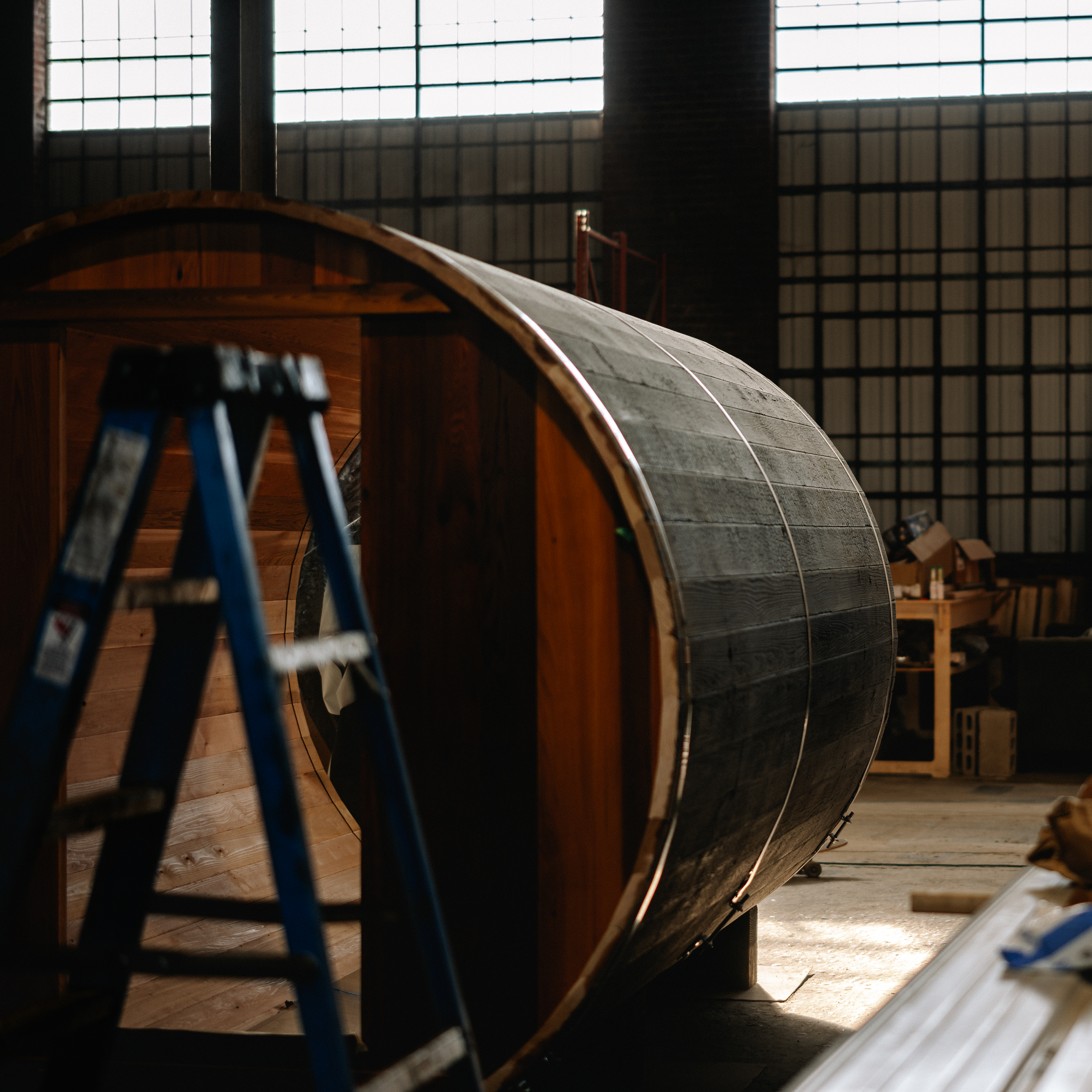
Stave Thickness: The 2-Inch Lumber Trick
A 2x4 is not 2 inches wide. It has not been for decades. The lumber industry standardized on nominal sizing, and the actual measurement of a standard 2x4 is 1.5 inches by 3.5 inches. Most buyers know this in the abstract. Most never think to apply it when shopping for a barrel sauna.
They should. Stave thickness is one of the most consequential specs in barrel sauna construction, and the nominal vs. actual distinction is exactly how some manufacturers market specifications that sound better than they are.
How Nominal Sizing Works
Dimensional lumber in North America is sold by nominal size, which was historically the rough-cut size before the board was dried and planed smooth. A 2-inch nominal board finishes at 1.5 inches. A 1.5-inch nominal board finishes at 1.375 inches (roughly 1-3/8 inches). The nominal number is always larger than the actual measurement, and the gap is consistent enough to be predictable.
In the barrel sauna market, this creates a specific problem: manufacturers who want to advertise a number that sounds impressive have a ready shortcut. "2-inch staves" sounds like genuine thickness. The actual measurement may be 1.5 inches. "1.5-inch staves" sounds like the premium spec. The actual measurement might be 1-3/8 inches.
When a manufacturer does not specify nominal vs. actual, assume the less favorable interpretation. The spec that reflects well on the product gets listed plainly.
One Board. Four Jobs.
This board is the interior of your sauna. It's also the structure. The insulation. And the exterior. All four. One board.
Every other construction category in residential building uses layers. A house wall is drywall, vapor barrier, insulation, sheathing, air gap, siding -- six or seven distinct materials, each doing a single job. In a barrel sauna, the stave does all of it at once. There is nothing behind it. Nothing in front of it. The stave is all of it.
That is why thickness is not a minor specification. It is the specification. When the stave is thin, it is thin at all four jobs simultaneously.
The interior. The surface you feel when you lean back. The face that absorbs moisture and releases it through the session. What shows checking and cracking first when the wood is under stress. Clear-grade Western Red Cedar at the right thickness is smooth, tight at the joints, and stays that way. Below the thickness threshold, you see joint gaps earlier, edge cracking sooner, and a surface that signals the barrel is working harder than it should.
The structure. A barrel sauna has no stud frame. No sheathing behind the wall. The stave is carrying load under band-compression joinery tension and holding the barrel round through thousands of thermal cycles. Stave mass determines how well the barrel maintains shape as the wood moves through session-level and seasonal expansion. A thinner stave has less structural reserve -- more vulnerability at the tongue-and-groove interface, where the profile cut already removes material from a board that cannot afford the loss.
The insulation. Thicker staves hold heat more effectively. The difference between 1-3/8-inch and 1.5-inch true is modest in isolation, but it compounds with everything else. A thinner stave loses heat faster at the wall face. In a Minnesota or Wisconsin winter, the stove works harder to maintain temperature, and session recovery time between rounds increases. For commercial operators running multiple sessions daily, that cost adds up across a season.
The exterior. The outer face of the stave is the exterior finish of the sauna. No siding layer. No housewrap. The stave itself faces rain, UV, and temperature swings directly. Clear-grade cedar handles this without additional treatment. The Yakisugi finish works by charring the exterior face of the stave directly -- which means the stave needs the thickness to withstand that process without compromising what is left behind. A thinner stave is more vulnerable at the exterior precisely because it has less material between the surface and the tongue-and-groove profile cut underneath.
When you see a stave thickness spec below 1.5 inches actual, you are not looking at a compromise in one dimension. You are looking at a compromise in all four.
What Kit Builders Actually Deliver
Almost Heaven, the market-leader in entry-level barrel sauna kits, uses staves that measure approximately 1-3/8 inches actual thickness. Their marketing does not prominently disclose this. The staves are also permanently screwed into end panels during assembly, which prevents the free movement that allows a barrel to breathe through thermal cycling. The combination of thinner staves and fixed construction is the structural reason that kit saunas have the lifespan they do.
SaunaLife uses staves at 1.65 inches actual, which is genuinely above average for the kit tier. Their construction still involves permanent screw assembly, but the thicker stave gives them a real spec advantage within that segment.
Redwood Outdoors does not disclose stave thickness on their product pages at all. For a fully assembled delivered product at their price point, this is a significant transparency gap. A specification that helps sell a product gets listed. When it is not there, the question of why is worth asking before purchasing.
The Construction Method Compounds Everything
Stave thickness and construction method are not independent variables. A thick stave that is permanently screwed into position will still develop stress over time as the wood tries to move and the fasteners resist. The screw points become the failure locus: checking initiates at the fastener hole, moisture enters, and the cycle accelerates.
A thinner stave in a band-compression construction, where each board moves freely in its groove, will outperform a thicker stave that is locked in place. The ideal is thick and free. That combination lives at the custom-built tier.
Stave Specs by Builder
The Question to Ask Every Builder
Before purchasing any barrel sauna, ask for stave thickness as an actual measurement, in writing, on the spec sheet. Then ask how the staves are fastened.
The combination of actual 1.5 inches (minimum) and freely moving stave construction is the meaningful spec. Either element alone is incomplete. A thick stave that is screwed still has a structural ceiling. A freely moving stave at 1-3/8 inches actual is better than screwed but below the thermal mass standard.
For a cedar barrel sauna that is expected to perform for 25 to 30 years, both specifications need to be present. Nominal sizing language and undisclosed specs in this market are almost always telling you something the manufacturer would rather you not calculate.
Frequently Asked Questions
What is a good stave thickness for a barrel sauna?
The standard benchmark is 1.5 inches actual (not nominal). At this thickness, the stave provides adequate thermal mass, tolerates tongue-and-groove profile cutting without structural vulnerability at the edges, and contributes meaningfully to the barrel's structural integrity under compression band tension. Below 1.5 inches actual, heat retention decreases, edge durability decreases, and the tolerance for thermal cycling diminishes. Above 1.5 inches actual, you get more thermal mass, which improves heat-up time efficiency and session consistency.
Why do some manufacturers not disclose stave thickness?
It is worth asking directly. When a spec is not disclosed on a premium-priced product, it is generally because the spec is not the selling point the builder wants to lead with. Stave thickness is easy to verify once disclosed. If a manufacturer deflects or provides nominal sizing without clarifying actual thickness, treat the response as the answer.
Does the number of staves matter?
The number of staves determines the radius of the barrel and the width of each stave face. More staves at a smaller width create a rounder interior curve. Fewer staves at greater width create a more faceted interior. For a standard 6-foot or 7-foot barrel diameter, a higher stave count produces a smoother curve and tighter joints at the tongue-and-groove interface. This is a secondary spec after thickness and construction method, but it matters for long-term joint integrity.
How does stave thickness affect the sauna's performance in winter?
Significantly. Thicker staves reduce heat loss through the wall, which means the stove reaches and maintains target temperature faster in cold conditions. In a Minnesota or Wisconsin winter, the difference between 1-3/8-inch and 1.5-inch true staves is measurable in heat-up time and fuel or electricity consumption. For outdoor saunas in cold climates, this is a practical consideration that extends across every session for the life of the unit.
See the full kit vs. custom-built comparison for a complete breakdown of what separates tiers at every spec level. Request a quote for a Nomad build with true 1.5-inch clear-grade Western Red Cedar staves, built in Hudson, WI and delivered fully assembled.
Related saunas
- Yakisugi charred-cedar finish — The traditional Japanese finish on a Nomad barrel sauna.
- Custom barrel saunas, built to order — Backyard, mobile, floating, and commercial builds. No kits.
- Barrel sauna buyer's guide — Cost, sizing, and kit vs. custom — what to ask any builder.