Comparison 7 min read
Wood Fired vs. Electric Sauna
By Nomad Sauna
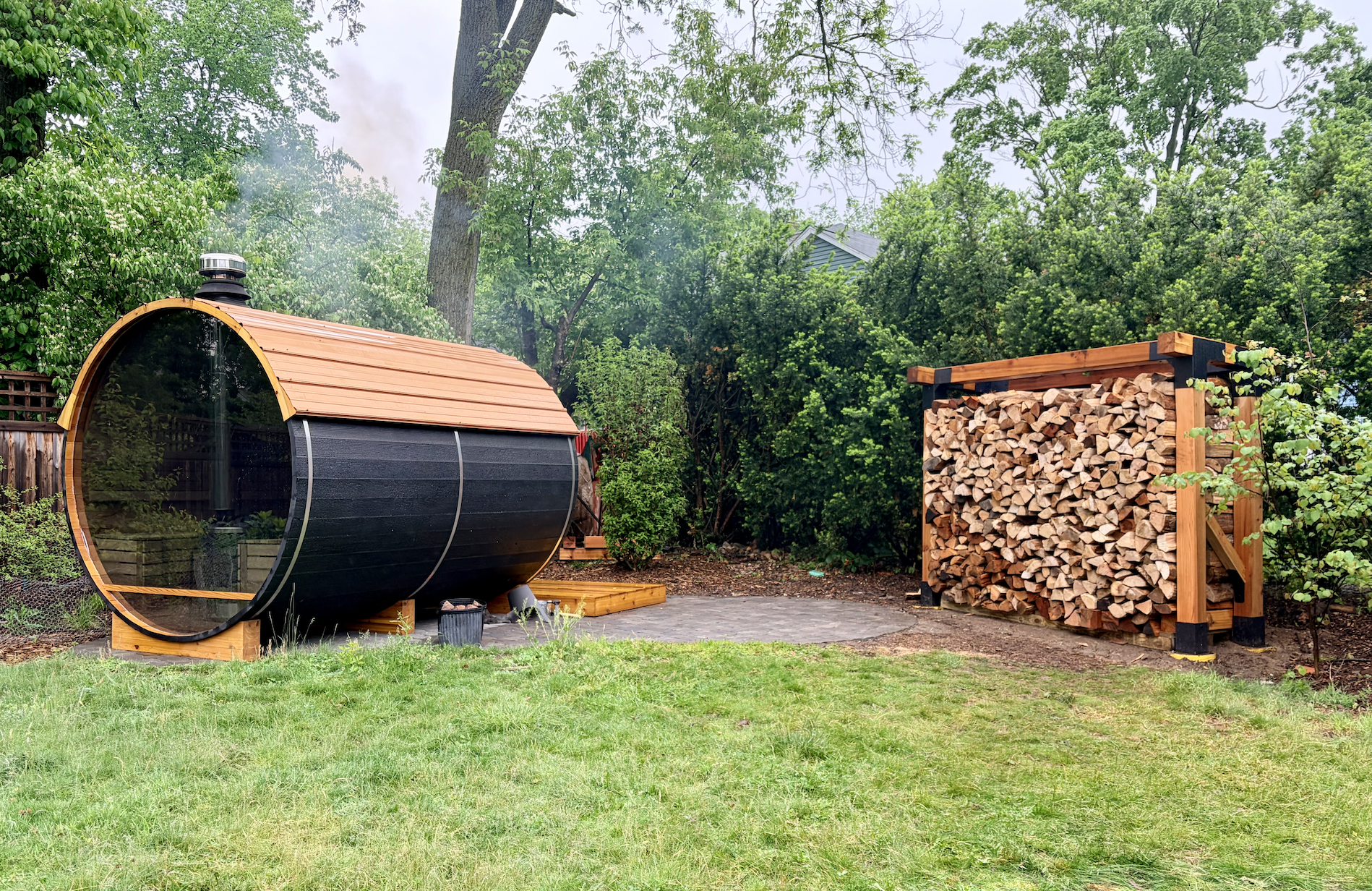
The second question almost every buyer asks. Here's both the short answer and the long one.
If you're in the market for a sauna, the stove question comes up early. On nearly every consultation call we run, it's the second thing buyers ask, right after sizing.
The framing is really pretty simple:
How much do you like starting fires?
Both stoves make a great sauna. Both can take water on the rocks. The decision isn't which is better, but which one fits how you're going to use the sauna.
The Short Answer
Wood-fired gives you radiant heat from a live fire, denser löyly, and full off-grid capability. 75 to 90 minutes to come up to temperature. You tend a fire. No electricians, no running cable.
Electric gives you precision and convenience. Tap an app, walk away, come back to a ready sauna. Same ability to throw water on the rocks. About a dollar a session to run in your home.
One hard rule: on a mobile sauna, electric isn't an option. Reason explained below.
How the Heat Differs
First-time wood-fired users almost always say the same thing: it feels different.
That's physics, not marketing. A wood stove with a loaded stack of stones produces more radiant heat relative to convective heat than an electric element. Radiant heat warms your body directly without superheating the air. The sauna feels deeply warm without the dry, abrasive edge some electric saunas have at the same temperature.
There's also thermal mass. A loaded wood stove is a heat reservoir, so output is essentially continuous. Electric elements cycle with the thermostat, which produces small temperature variations. Most people won't notice. Heritage sauna users, the ones who grew up with a real sauna in the backyard, almost always notice.
Electric isn't inferior. A properly sized electric heater in a well-built barrel produces great heat. The two heat sources are slightly different sensory experiences, and one of them is closer to what sauna has been for a thousand years.
Time, Cost, Maintenance
Heat-up time. 75 minutes to 165°F. 90 minutes to 180°F. Same range on both stove types, sized correctly. The difference is what "on" requires from you: an app tap with electric, kindling and a fire with wood.
Running cost. About a dollar a session on our Homecraft electric stoves. Four sessions a week, $20 a month. Wood-fired runs $15 to $25 in dry hardwood per multi-session day. Cheaper if you cut your own.
Maintenance. Electric is essentially zero. Wood means ash removal every few sessions and a chimney sweep once or twice a season. Whether that's a feature or a friction is up to you.
Side by Side
The Mobile vs. Stationary Rule
If you're buying a Mobile Series sauna, your stove options are wood or propane. We don't offer electric on mobile builds. Any builder who does is selling you a problem.
The reason is physics. Road vibration shifts stones inside an electric heater. Stones grind against the elements. Elements get knocked back and forth. Elements wear, crack, fail. That's not a commercial-grade product. Every mobile sauna trailer we build runs a wood-fired or propane stove.
Propane stoves are almost exclusively a west-coast product for us. That's where frequent seasonal fire bans push operators off wood for months at a time, and where the LP supply chain is dialed in enough to make it practical. East of the Rockies, burn bans are rare and most mobile operators run wood. If you're buying a mobile and you're not on the west coast, the default is wood-fire, although some operators do choose propane because of convenience. Some business operators perceive less risk in propane, especially when doing private rentals.
On a stationary backyard build, all three options are in play: wood, electric, propane. The choice comes down to use pattern. Suburban property, 240V from the panel, weekday evenings: electric. Rural property, woodlot in the yard, wants the ritual: wood. No obvious electrical capacity: propane might make sense.
For commercial barrel saunas running sessions all day every day, electric is the practical default when you have back-to-back bookings.
The Löyly Test
Buyers with any real sauna background ask one question early: can I throw water on the rocks? They know that the Finns have a dedicated word for how steam is released when water hits hot stones: löyly.
Answer's the same on both stoves: yes. Nomad Sauna will never sell a stove you can't put water on. All of the stoves we use have a rock capacity of at least 200 pounds, and as much as 550 pounds, which generates strong radiant heat and a full steam.
The difference is character and charm, not capability. Wood-heated stones produce a denser, longer-lasting steam. Because there's more thermal mass under the stones, fire keeps replenishing. Electric stones produce a cleaner, faster-recovering pour.
Just remember: If you can't pour water on the rocks, you don't have a sauna, you have a hot room.
Stove Sizing
This is honestly the more direct and operational question that most buyers should be looking at. We've had buyers ask if they can get a bigger stove in a sauna than we recommend, and we always say the same thing: you would rather have the right stove than a bigger stove, 100% of the time.
A 6 kW heater dropped into an under-insulated rectangle that needed 9kW. A 12 kW heater hammering away in a tight 8-foot barrel that only needed 9kW. Wrong size stove is the most common reason a sauna doesn't feel right.
(See our buyer's guide on kit vs. custom-built for why barrel-and-heater matching matters more than the stove brand on the label.)
How to Decide
If you enjoy the ritual of starting a fire, wood-fired is the right answer and you already knew that. If you want to tap an app when you leave work and have a sauna ready when you get home, electric is the right answer. If you're building mobile, the answer is wood or propane. And if you’re on the west coast, propane is the more practical option over wood.
Walk through stove sizing for your build: schedule a consultation or browse our residential builds.
FAQ
Is wood-fired actually better than electric?
Different, not better. Wood produces more radiant heat, more thermal mass, and the fire-tending ritual. Electric is consistent, fast, and clean. Both deliver real löyly.
What does an electric sauna cost to run?
About a dollar a session on Homecraft. Roughly $20 a month at four sessions a week. Running cost shouldn't be the deciding factor.
Why no electric on mobile saunas?
Road vibration shifts stones inside the heater and destroys the elements. We've seen failures in the first season on competitor builds.
Can I throw water on the rocks with an electric stove?
Yes. Every stove we install, wood or electric, is built for water on a proper stone bed.
What about propane?
Third real option. Common for mobile operators in burn-restricted areas and rural residential properties without easy electrical capacity. We use Torch propane stoves. In practice, propane mobiles are almost exclusively a west-coast sale for us, where frequent fire bans push operators off wood for stretches of the year.
Tags: wood fired stove, electric stove
Related saunas
- Custom backyard barrel saunas — Delivered fully assembled, ready to fire the first night.
- Custom barrel saunas, built to order — Backyard, mobile, floating, and commercial builds. No kits.