Culture 11 min read
What Is Löyly? The Finnish Word That Explains a Real Sauna
By Nomad Sauna
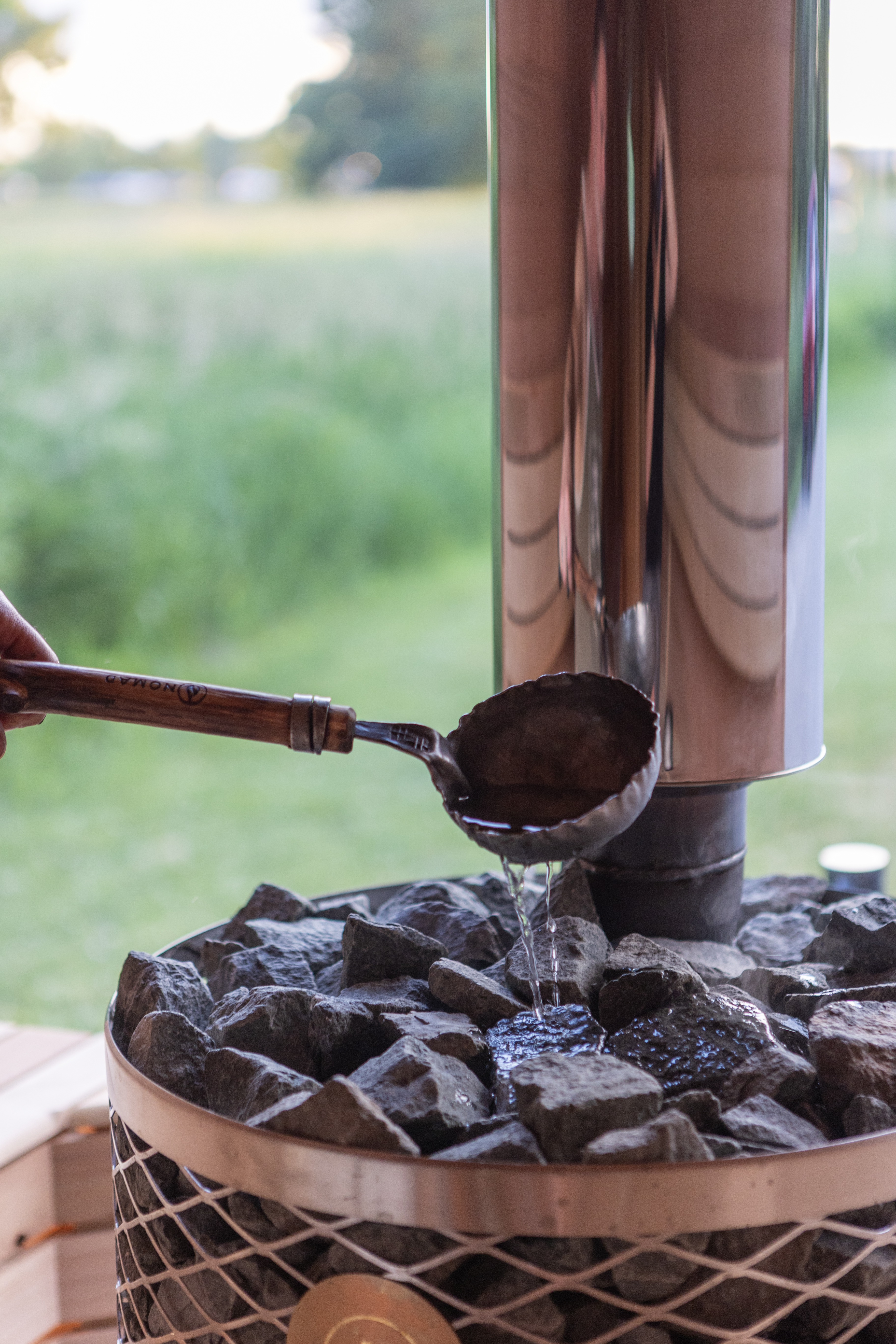
Löyly (say it: LOY-loo) is the steam that rises off hot sauna stones the instant water hits them. It's not just humidity. In Finnish, the word originally meant "spirit," "breath," or "soul," and Finns still treat it that way: a sauna without good löyly isn't really a sauna, no matter how hot the room gets. Everything about how a sauna is built and used, from the stones to the ladle to the wood the room is made of, exists to produce it.
Most English-language sauna content treats löyly as a synonym for "steam" and moves on. That's a translation error with real consequences for anyone shopping for a sauna, because a room that hits 180°F with no löyly is a dry box, not a sauna in the sense Finns mean the word. Understanding what löyly actually is changes what you should be looking for when you buy one.
The word itself
Löyly has roots that go back further than sauna culture itself. Linguists trace it to a Proto-Uralic root meaning "spirit," "breath," or "soul," a root that survives in related languages across the Finno-Ugric family: Karelian löyly, Estonian leil, and, more distantly, Hungarian lélek ("soul"). Finnish has a separate, ordinary word for steam in the scientific or general sense: höyry, the word you'd use for the steam coming off a kettle or an industrial pipe. Löyly is reserved specifically for the steam that comes off hot stones in a sauna. Finns don't use the two words interchangeably, and that distinction is the whole point: löyly isn't generic water vapor, it's the specific, ritual burst of heat and humidity that a sauna is built to produce.
That's also why "steam" is a weak English translation. Steam describes a physical state of water. Löyly describes an experience: the wave of heat that hits your skin and lungs, the way it changes the character of the room for the next several minutes, the fact that a good one can make an 170°F room feel hotter than it did a second ago without the thermometer moving at all. Sauna cultures outside Finland (and now most of the English-language sauna industry) borrowed the concept without borrowing the precision of the word, which is why "throwing water on the rocks" gets treated as a minor detail instead of the actual point of the room.
How löyly is made
The mechanics are simple. Water is ladled onto stones that have been heated by a wood-fired, electric, or propane stove to somewhere in the 400°F-plus range. The water flash-vaporizes on contact, releasing a burst of steam that raises both the humidity and the perceived heat of the room almost instantly. The person doing the ladling, traditionally called the löylynheittäjä ("the one who throws the löyly"), controls how much water goes on and how often, which is functionally the same as controlling the intensity of the whole session.
Three things determine whether that burst of steam is good löyly or a wet, flat disappointment:
Stone mass and surface area. More stone mass holds more heat, and more surface area gives water more contact points to flash into steam on. A thin layer of small stones over a low-wattage element produces a weak, short burst. A properly sized heater with enough stone coverage produces a longer, more even löyly that doesn't collapse the second the water hits.
Stone type. Not all rock belongs in a sauna. Porous or moisture-retentive stones (many types of river rock and granite) can crack, pop, or explode under repeated heat-and-water cycling, because trapped moisture expands faster than the stone can handle. Dense, low-porosity volcanic stone, like peridotite and olivine diabase, handles the thermal cycling without breaking down. This is a genuine safety and longevity spec, not a marketing detail: it's the difference between stones that last for years and stones that need replacing (or that throw fragments) within a season.
Room construction. This is the part almost no sauna content covers, and it's where the building itself becomes part of the löyly equation. Wood that's tightly sealed, painted, or bonded with glue doesn't behave neutrally when it's hit with a burst of 400°F-plus steam. Glued joints and finished surfaces can off-gas under that kind of heat, and a room that's been over-sealed traps moisture instead of managing it. Clear-grade Western Red Cedar built with band-compression joinery (no glues, no screws) is dimensionally alive: the wood absorbs and releases moisture through use, which is part of why cedar has been the standard sauna wood for generations. A room built that way handles repeated löyly the way it's supposed to. A room built from knot-grade lumber, glued panels, or synthetic sealants is fighting the process instead of participating in it.
What löyly actually feels like
Describing löyly to someone who hasn't felt it is a little like describing a wave to someone who's only seen a lake from a photograph. The room is already hot, somewhere in the 170–190°F range for a typical session. Then water hits the stones, and for two or three seconds there's an audible hiss, a visible rush of steam off the heater, and then it arrives: a wall of heat that seems to raise the temperature of the room by ten or fifteen degrees without the thermometer actually moving. Your skin registers it first, then your airway. A well-built löyly peaks fast and eases off over the following minute or two, leaving the room measurably more humid than it was, until the next ladle resets the cycle.
A poorly built one does something different. Either it's weak, a small hiss and a faint dampness that barely registers, because there isn't enough stone mass to sustain a real burst, or it's harsh and one-note, a scalding blast with nothing behind it, because the stones are shallow and the water has nowhere to go but straight back out as flash steam with no lingering warmth. Neither is löyly in the sense Finns mean the word. The good version has body to it: a rise, a hold, and a slow fade that makes you want another round in a few minutes, not immediately.
Wood-fired vs. electric: does the heat source change the löyly?
Finns argue about this constantly, and there's a real physical basis for the debate. A wood-fired stove like the IKI typically carries more stone mass than a comparable electric unit, and the combustion process itself introduces a small amount of ambient moisture and a faint wood-smoke character to the air that an electric element never will. Many sauna traditionalists describe wood-fired löyly as rounder or softer for exactly that reason: more stored heat, slightly different air chemistry, and a stove that was heating for an hour or more before the first ladle rather than reaching temperature on a thermostat.
That doesn't make electric löyly inferior, just different, and it's a legitimate choice on its own merits: no fire tending, no firewood storage, instant-on convenience, and (Nomad's Homecraft heaters scale from a 9 kW unit on an 8-foot build up to a 12 kW unit on a 12-footer) enough stone-loaded capacity to produce a genuinely good burst as long as the heater is sized correctly for the room. The mistake buyers make isn't choosing electric over wood, it's under-sizing the heater for the room's volume, which produces exactly the weak, thin löyly described above regardless of fuel type. A heater that's correctly matched to cubic footage, whether that's a wood-fired IKI or an electric Homecraft unit, is what actually determines whether the löyly has any substance to it.
Löyly and the savusauna
The deepest, most historically loaded version of this experience comes from the savusauna, the traditional Finnish smoke sauna: a chimney-less room where a wood fire heats a massive stone mass for hours, then gets extinguished and vented before anyone bathes. Because there's no chimney pulling heat out and no thin sheet-metal stove trying to reheat on demand, a savusauna's stone mass holds an enormous amount of stored heat, which produces a löyly that Finns widely describe as softer and more enveloping than what a smaller electric heater can produce. Very few builders in North America work with anything close to that stone mass today, but it's the historical benchmark the whole concept comes from, and it's worth knowing about even if you're buying a modern wood-fired or electric barrel sauna.
Löyly by sauna type
Not every kind of "sauna" on the market is capable of producing löyly at all, and that's worth knowing before you buy one.
If a listing calls something a "sauna" and it doesn't involve stones and water, it's worth asking what you're actually buying. Infrared cabins are a legitimate, different wellness product, but they're not löyly-based sauna, and marketing that blurs the line does buyers a disservice.
Why this matters when you're buying a sauna
The practical takeaway isn't etymology trivia, it's a buying filter. If good löyly depends on adequate stone mass, dense non-explosive stone, and a room that manages moisture instead of fighting it, then a kit sauna built from thin, knot-grade lumber with a minimal heater and a shallow stone tray is working against the exact thing that makes a sauna worth having. This is the kit vs. custom-built question, seen from the löyly side instead of the construction side: the same corners that get cut on wood thickness and joinery in a flat-pack kit tend to get cut on stone mass and heater sizing too.
Every Nomad barrel sauna, whether it's a Placed Residential build for the backyard, a Mobile Series unit on the road, a floating platform, or a commercial installation, is built from the same clear-grade cedar and band-compression construction specifically because that's what lets the room do its job once the water hits the stones. The barrel shape itself helps too: a curved ceiling circulates heat and steam more evenly across the room than a flat-walled box, so the löyly reaches every bench instead of pooling near the heater.
Löyly across a full session
In Finland, löyly isn't a one-time event at the start of a sauna visit, it's the rhythm of the whole session. A typical round runs somewhere in the 10-to-20-minute range: a few ladles spread across the round rather than dumped all at once, each one building the heat a little further before the next. Between rounds, bathers step out to cool down entirely, often outdoors, sometimes into a lake, a cold plunge, or just the open air, before going back in for another round. The contrast between the löyly-heavy heat and the cold break is treated as a single continuous ritual, not two separate activities. Two or three rounds is typical for a normal session; more for a proper Saturday sauna, which remains a weekly institution in much of Finland.
This is also why sauna size and layout matter more than people expect. A cramped room where every bench is close to the heater gets hit with the full force of every löyly burst, which can be overwhelming for anyone not sitting up high. A properly proportioned barrel sauna, with bench tiers at different heights and enough interior volume for the steam to spread before it reaches the far wall, lets bathers self-select their intensity: lower and closer to the heat, or higher and further back, without leaving the room.
Sauna etiquette around löyly
Löyly is also a social ritual, not just a physical one, and it has informal rules in Finland that are worth knowing:
- One ladle at a time. Small, controlled additions build heat gradually. Dumping a large volume of water on the stones all at once produces a scalding blast, not good löyly, and can genuinely hurt the people closest to the heater.
- Ask before you throw. In a shared sauna, adding water affects everyone in the room. The löylynheittäjä role carries a social responsibility: read the room before adding more.
- Give it a moment. Let one round of löyly settle before adding another. Constant additions don't intensify the experience, they just keep the room in a state of steam without ever letting the heat build the way it's meant to.
FAQ
What does löyly mean in English?
There's no exact English equivalent. The closest functional translation is "sauna steam," but the word originally meant "spirit," "breath," or "soul," and Finns use it specifically for the steam produced when water hits hot sauna stones, not for steam in general.
Is löyly the same as humidity?
Not exactly. Humidity is a measurable condition of the air. Löyly is the specific burst of heat and steam created by throwing water on hot stones, which momentarily raises both humidity and perceived temperature. A humid room without that water-on-stones cycle isn't producing löyly in the traditional sense.
Can you get löyly in an electric sauna?
Yes, as long as the heater is stone-loaded (has rocks on top designed to hold water) rather than an enclosed or infrared-style unit. Stone mass and coverage still matter for the quality of the löyly, but the mechanism works the same way it does with a wood-fired stove.
Do infrared saunas have löyly?
No. Infrared units heat the body directly with infrared light and don't use stones or water, so there's no steam cycle at all. It's a different category of product.
What kind of stones are best for löyly?
Dense, low-porosity volcanic stone, such as peridotite or olivine diabase, holds up to repeated heat-and-water cycling without cracking or popping. Porous river rock and some granites can trap moisture and fail under thermal stress, which is both a löyly problem and a safety issue.
A room can only produce real löyly if it's built to handle it: the right stone mass, the right stove, and wood that manages moisture instead of fighting it. That's the standard every Nomad barrel sauna is built to, handbuilt in Hudson, Wisconsin from clear-grade cedar with no glues and no screws. Request a quote or read the Buyer's Guide to see what that build actually involves.
Related saunas
- Custom backyard barrel saunas — Delivered fully assembled, ready to fire the first night.
- Custom barrel saunas, built to order — Backyard, mobile, floating, and commercial builds. No kits.