Comparison 7 min read
What Happens When You Assemble a Kit Sauna
By Nomad Sauna
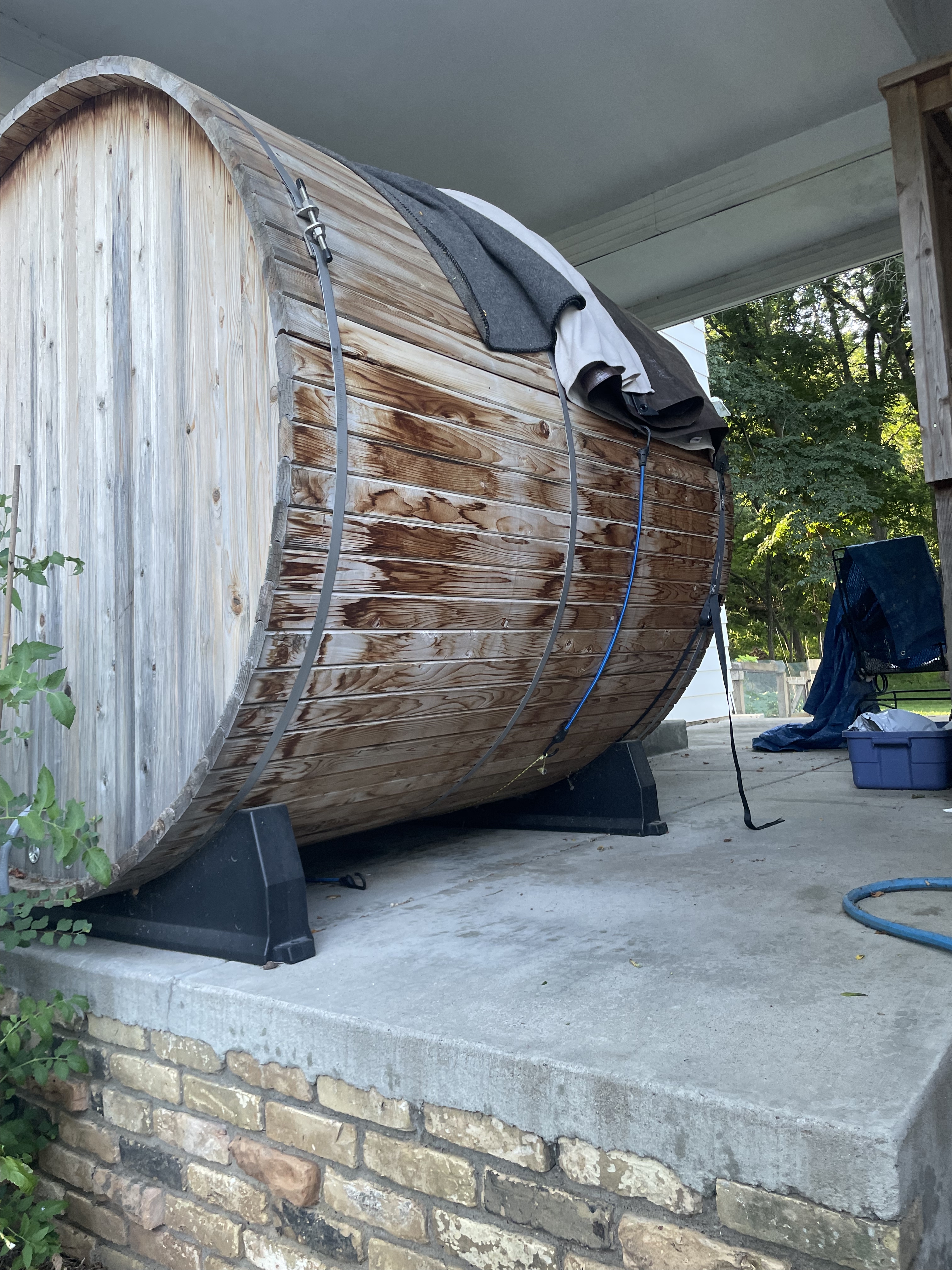
A barrel sauna kit arrives as a pallet of pre-cut staves, hardware, and an instruction manual — not a finished sauna. Assembly is a real multi-day project involving a cordless drill, a rubber mallet, a level, and a set of filler staves cut to close out whatever gap is left when the last full-size stave won't fit. None of this is a secret; it's documented in the manufacturer's own assembly manual. Here's what it actually involves, and what changes about the sauna once you're the one who built it.
The tools list tells you what you're in for
The standard barrel sauna installation manual used across most kit brands — the same document family sold under multiple retailers including Almost Heaven-style barrel kits, Costco, and other importers — calls for: a cordless drill, rubber mallet, hammer, framing square, Phillips and flathead screwdrivers, utility knife, level, and wrench. That's a legitimate construction project, not an afternoon of snapping panels together.
Step 1: Fasten the base ring to the cradle
Assembly starts at the floor. The manual instructs builders to "fasten every other stave to each cradle" using 2" screws — meaning half the staves are screwed directly into the base structure before the barrel shape even starts to take form.
Step 2: Nail the rising staves — then stop
As the staves stack and the room rises, the instructions call for hammering "a 2\" nail through every second or third stave into the front and back end panels." Then comes the part most buyers don't expect: the manual explicitly says to "stop using nails about halfway up the sides" and to leave the remaining staves unnailed. The upper half of the barrel is held in place by band tension and friction fit alone, not fasteners.
Step 3: The final stave doesn't fit — that's expected
By design, "the remaining space will not accommodate a full-size stave." The fix is a set of filler staves — pre-cut pieces in various widths — installed by "tilting the adjacent staves up, insert and mallet in the filler staves, and push them all back into place." This isn't a defect in one bad kit; it's a built-in step in the standard kit assembly process, because a barrel's circumference almost never divides evenly into full-width staves.
Step 4: Level the pad, or the fit gets worse
The manual is direct about this: "an uneven installation surface can result in poor-fitting staves leading to poor sauna function." Every fitting problem in the steps above compounds if the foundation underneath isn't level and stable before assembly starts.
Step 5: Expect to retighten the bands after first use
Cedar carries moisture from milling. Once the sauna is heated for the first time, "the staves may shrink as the high heat evaporates that moisture," and the manual notes this "may require you to tighten the bands even further" — a maintenance step, not a one-time assembly task. Some water seepage at the tongue-and-groove joints during this shrinkage period is called out as expected and not harmful, a function of "the porous nature of softwoods as well as the tongue and groove design of the staves."
What changes with screws, nails, and filler staves in the mix
Every fastener that penetrates a stave is a point where wood and metal move differently under heat. Screws driven into cedar during initial assembly loosen as the wood dries and shrinks around them — the same cycle the manual describes needing "even further" band tightening to compensate for. Filler staves, cut on-site to close the final gap, are the least uniform pieces in the whole barrel, fitted by hand with a mallet rather than milled to the same tolerance as the rest of the run.
This is the kit vs. custom-built distinction in practice, not in theory. A custom-built barrel uses band-compression joinery from the start — no screws or nails through the staves — so there's no fastener loosening to chase down after the first heat, and no filler-stave fit variance built into the final assembly. Nomad barrels are hand-fitted and delivered fully assembled; see the build process for how that comparison plays out stage by stage.
Who a kit assembly actually makes sense for
None of this makes a kit a bad purchase in every situation. Kits work well for a short-timeline use case — a vacation property, a rental staging setup, or simply trying out sauna ownership before committing to a permanent installation. A buyer in that position is often optimizing for the lowest entry price and is willing to spend a weekend assembling the unit and revisiting band tension after the first few sessions in exchange for that lower cost.
Where kit assembly becomes a harder trade-off is on a permanent backyard installation meant to last decades. Band retensioning itself is normal, expected maintenance on any barrel sauna, kit or custom — that's not what changes. What changes is the screws-and-filler-stave construction method described above, which adds fastener loosening on top of that routine band care, and leaves the owner working from a manual instead of a builder who knows the unit. A buyer building something permanent is usually optimizing for longevity and wants to talk to the people who built the unit if something needs attention years down the line, which is a different priority than getting the lowest possible price on day one.
The capacity gap buyers run into
Assembly fit isn't the only place a kit's marketing and the finished sauna diverge — capacity claims are another. Sisu, whose barrel sauna kits are sold through retailers like Rogue Fitness and Titan Fitness, markets its Eddy barrel as fitting "2–4 people" in the specs, while the same product page separately describes it as a sauna that "comfortably fits two." That's not a typo buried in fine print — it's the brand's own copy contradicting itself on how many people the unit actually seats.
We heard a version of this firsthand from a commercial buyer — a gym owner who'd bought a Sisu kit for their facility. Once it was assembled, the finished sauna felt smaller than the capacity claims had suggested, and getting it together wasn't the half-day, two-person job the marketing implied either — they ended up on the phone with customer service for a meaningful chunk of the build to get it right. One buyer's experience isn't a universal verdict on any kit brand, but it's a useful reminder that a kit's marketed capacity and assembly time are targets, not guarantees, and the gap tends to show up right when there's no one on-site to help close it.
Kit assembly reality vs. custom-built delivery
FAQ
Do all barrel sauna kits use screws and nails?
Most flat-pack kit brands use a version of this same assembly method — screws into the base and lower staves, nails partway up, then friction and band tension for the upper staves. It's documented in the standard barrel sauna installation manual used across several retailers.
Is it normal for a kit sauna to leak or seep water when new?
Manufacturer documentation for this assembly method notes that some seepage at the tongue-and-groove joints is expected during the initial shrinkage period and is described as not harmful to the structure. It's still worth knowing before you're staring at damp seams in week one.
Can a filler stave be avoided?
Not with this construction method — the circumference of a barrel almost never divides evenly into full-width staves, so a set of cut-to-width filler pieces is a standard part of kit assembly, not a flaw specific to one order.
How long does kit assembly actually take?
Manuals for this style of kit call for a real tool list and a multi-step process — base ring, rising staves, roof, hardware, and band tensioning. Most buyers should plan on a full weekend with a second person helping, not a single afternoon.
Do kit saunas actually fit as many people as they're marketed for?
Not always. Sisu's Eddy barrel, for example, is listed as fitting "2–4 people" in its specs but described elsewhere on the same product page as comfortably fitting two — worth sizing against your actual headcount rather than the top end of a marketed range, especially for a commercial or gym install where capacity is the whole point.
What's the alternative if I don't want to assemble anything myself?
A custom-built barrel sauna from Nomad ships fully assembled and hand-fitted in our Hudson, Wisconsin shop — no fasteners to chase down, no filler staves, no assembly weekend. Band retensioning is still a normal part of owning any barrel sauna, kit or custom, and it's something our team walks every owner through rather than leaving them to figure out from a manual. Request a quote to compare what a custom build includes.
Considering a kit vs. a custom-built barrel? Read the full Buyer's Guide or schedule a 30-minute consultation to talk through what fits your space and budget.
Related saunas
- Custom barrel saunas, built to order — Backyard, mobile, floating, and commercial builds. No kits.
- Barrel sauna buyer's guide — Cost, sizing, and kit vs. custom — what to ask any builder.
- Request a backyard design consultation — Tell us about your property. We'll design a sauna around it.