Comparison 15 min read
Barrel Sauna vs. Traditional Box Sauna
By Nomad Sauna
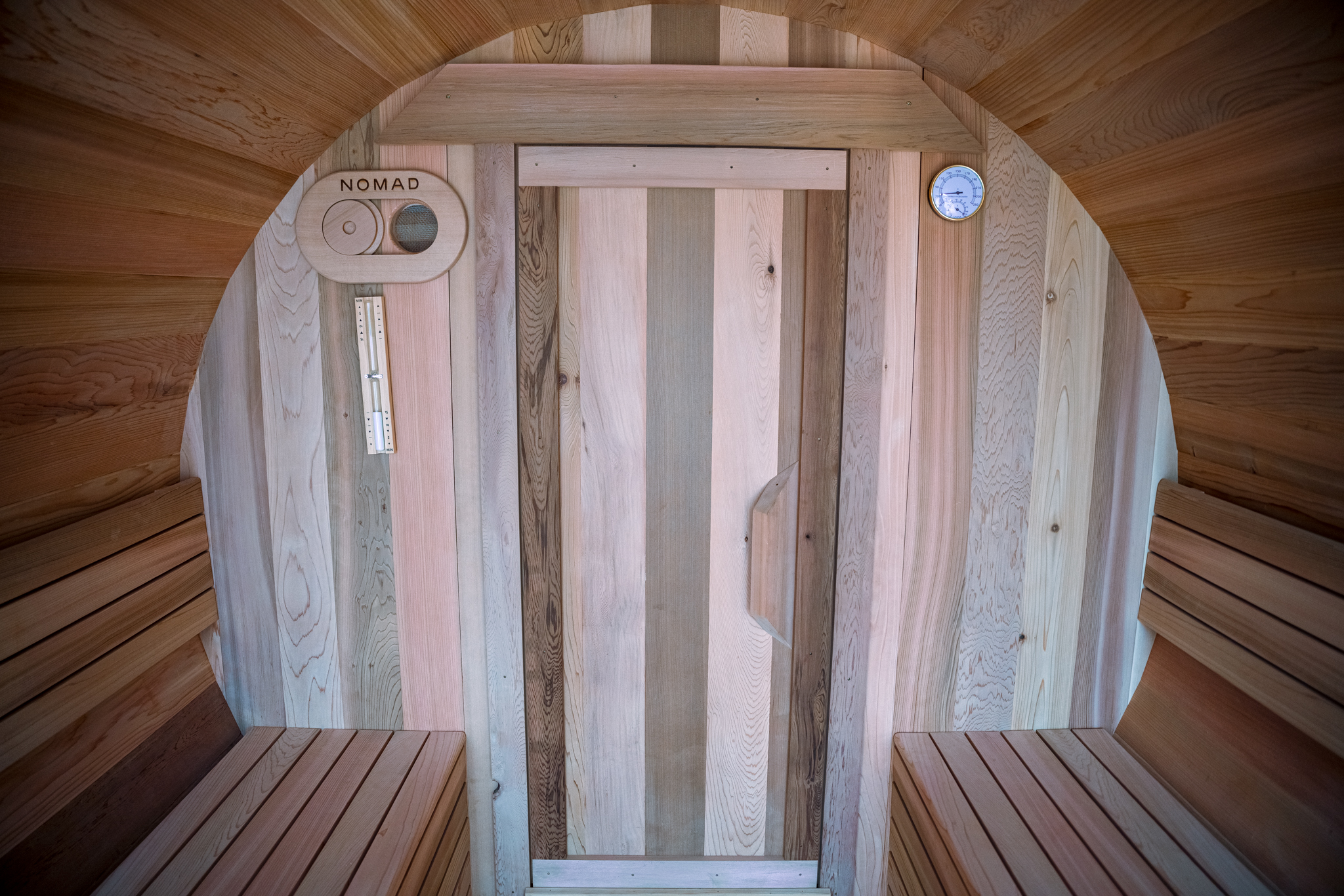
Barrel Sauna vs. Traditional Box Sauna
Most barrel saunas sold in North America are not good saunas. Thin staves, knot-grade wood, screws driven straight through curved walls, seams that open within a couple of winters. If the only barrel sauna you have spent time in is one of these, it is reasonable to conclude the barrel form itself is overrated.
It isn't. The problem with those saunas has nothing to do with the shape. It has everything to do with how they were built. A rectangle assembled the same way, cheap wood and screws, has the exact same problems. The shape is not what fails. The construction is.
That distinction also settles the older debate underneath this one. The rectangle won market share for construction reasons, not sauna reasons. The box sauna dominates because it is cheap and easy to frame, insulate, and roof. Not because it does anything better than a properly built barrel when you are actually sitting in one.
Understanding why that is true requires knowing what a sauna is actually trying to do with heat.
How Saunas Actually Heat a Room
A sauna's job is to hold a precise temperature across the usable space while delivering löyly, the steam released when water hits hot stones, in a way that raises the apparent temperature without raising the actual air temperature. The challenge is physics: heat rises. Any enclosed room will have a significant temperature gradient from floor to ceiling. The ceiling and the upper walls will be dramatically hotter than the floor. The bench, ideally, sits in the hot zone.
In a rectangular room, that gradient is steep and stable. Hot air collects at the ceiling and the lower half of the room stays substantially cooler. This is why traditional Finnish saunas use two-tier bench seating. It's not tradition. It is the engineering fix for a physics phenomenon.
The rectangle did not win because it heats well. It won because boxes are easier to frame than curves.
The Barrel's Geometric Answer
The barrel shape addresses the stratification problem structurally.
The curved ceiling sets up a natural convection loop. Hot air rises, reaches the curved surface overhead, and flows along the curve back down toward the walls and floor, where it recirculates rather than pooling at a flat ceiling. The temperature difference from floor to ceiling in a properly built barrel sauna is half what it is in a comparable rectangular room. That is why a barrel can run with a single bench level, everyone sitting at the same height, all experiencing approximately the same heat.
Cutaway diagram of a barrel sauna with a fully circular cross-section, showing hot air rising from the heater, curving continuously along the round wall, and returning across the floor deck
The convection loop inside a properly built barrel: heat rises, follows the round wall down, and returns across the floor before the heater sends it up again.
That single-bench geometry is not a limitation. It's the whole point. The sauna becomes more social, more equal, and less defined by where you can tolerate sitting.
The barrel's structural advantages extend beyond heat distribution:
No corners. Corners are the primary failure point in outdoor wood construction. Moisture infiltrates joints, freeze-thaw cycling widens gaps, and over time the corner details of a framed rectangular sauna require attention that the barrel, which has none, does not. A cylinder is a structurally self-reinforcing form.
Self-draining. Condensation and rinse water follow the curve to the low point and drain out. A flat-floored rectangular sauna requires deliberate drainage design that a barrel gets for free.
Material efficiency. A circle encloses the maximum interior volume for the minimum perimeter. You get more usable space per board-foot of cedar.
Portable by design. A barrel sits on cradle supports and requires no permanent foundation. It can be relocated without demolishing a slab. A box sauna built on a concrete or wood foundation cannot.
Looks more natural. Curves belong in a landscape in a way that right angles do not. A barrel sauna placed beside a tree line, a lake, or in a garden looks like it grew there. A shed with a chimney does not. This is aesthetic, not functional, but it is real.
Built Like a Barrel, Not Like a Box
A real barrel sauna is built on cooperage principles, the same craft that has made watertight wooden barrels for roughly 5,000 years.
Staves are milled to precise radial angles. Compression bands draw them together. The entire structure locks itself under tension. As moisture swells the wood, the staves press harder against one another and the barrel gets tighter rather than looser. Geometry is the fastener. There is no glue and no screws holding the barrel together.
This is the same principle behind a bourbon barrel that holds 53 gallons of liquid for years in a warehouse with no climate control and real freeze-thaw cycling, without a single nail or drop of adhesive.
A box sauna is framed, fastened, and insulated the way any small structure is. Screws and nails hold the assembly together. A barrel sauna built on box logic, curved walls but screw-fastened staves, violates the cooperage principle in the exact place it matters. The screws are a point of contact between metal and wood in a room that cycles between freezing and 185°F repeatedly. Over years of thermal cycling, the screws win the argument with the wood, and the staves open up.
Nomad's barrels use band-compression joinery. The wood moves, because it is a natural material and it always will. Nomad accounts for that movement. A box sauna, and most kit barrels, are built as if the wood will stay where you put it. It will not.
Most Barrel Saunas Are Badly Built
Here is the part of the barrel sauna market that rarely gets said out loud: the overwhelming majority of barrel saunas for sale today are built badly enough that they shouldn't be bought. Not because the barrel form is flawed. Because most of what gets sold as a "barrel sauna" was never built according to cooperage principles in the first place.
Two paths lead to a bad barrel. The first is the flat-pack kit: a pallet of pre-cut parts shipped for weekend assembly by the buyer. Almost Heaven, SaunaLife, and Redwood Outdoors operate in this tier. They are real products and they function as saunas in the loosest sense. But the construction compromises are consistent and severe: staves milled thin, typically 1 inch instead of 1.5, knotty wood instead of clear, and screws driven straight through the stave walls instead of stainless bands drawing them together under tension. In most cases, the bands are for show.
The second path is a small or unnamed builder using barrel geometry without the cooperage discipline behind it: cheap lumber, no true compression system, minimal attention to stave tolerance. These saunas can look identical to a properly built barrel in a listing photo. The difference only shows up after a winter or two, when the seams that were tight at delivery start to gap.
Every one of those shortcuts degrades the exact thing that makes a barrel worth choosing over a box in the first place. Thin, knotty, screw-fastened staves do not hold compression evenly. They open gaps at the screw points as the wood expands and contracts through the season. A kit barrel with tight seams on delivery day is very likely to show visible gaps within two or three winters of real use, because that particular barrel was never built to actually behave like one.
This is why "barrel sauna" is quietly doing two jobs as a term. It describes a shape, and it describes a construction method. A cooperage-built barrel behaves completely differently over years than a curved assembly of thin, knotty wood held together with screws that happens to get hot and look the same in a driveway. The bad reputation that a leaking, drafty barrel earns gets attached to the whole category. It belongs to the builder, not the barrel.
Kit Barrels vs. Custom Barrels: The Build Gap
The kit vs. custom-built divide in the barrel sauna market is the single most useful lens for evaluating any product on the shelf. A kit ships as a box of parts for the buyer to assemble. A custom-built barrel is shop-fitted by the people who built it and delivered complete. The construction difference, thin knotty-wood screw assembly vs. 1.5-inch clear-grade cedar band-compression joinery, produces genuinely different saunas that happen to get described with the same two words.
Clear-grade Western Red Cedar, the knot-free premium tier, is what the construction logic requires, not a marketing upgrade layered on top of it. Knots are structural weak points under extreme thermal cycling. They heat faster than the surrounding wood, respond differently to moisture, and over years can splinter or pop. The band-compression system that gives a real barrel its structural integrity requires staves milled to precision, and knot-grade wood does not mill consistently enough to hold those tolerances. Clear-grade and band-compression belong together. Knotty-grade and screws belong together. The price gap between the tiers reflects real material and labor differences, not markup.
Head-to-Head: Barrel vs. Box
When a Box Might Be the Right Choice
The barrel wins on almost every sauna-specific dimension, when it is actually built as one. There are a few situations where a box makes sense regardless.
Very large capacity. Commercial installations seating 20 or more people with an attached changing room, shower, or cold-plunge space are more practically configured as cabins. Nomad builds commercial barrel saunas up to 20 feet, but at the extreme end of the commercial spec, a rectangular building with dedicated utility rooms is sometimes the right engineering answer.
Integrated interior layout. A customer who wants a sauna that connects to an indoor space, or that shares plumbing and electrical with a nearby bath or wellness room, often finds a framed structure easier to integrate with existing architecture than a freestanding barrel.
Interior finish preferences. Some buyers want panoramic glass walls, stone tile floors, or infrared panels. These are possible in a barrel format, but they are easier in a box, and in some cases the feature is incompatible with the cooperage principle (a panoramic glass end wall, for instance, works on either form, but a glass-walled sauna with four glass sides is a box sauna, not a barrel).
For the standard residential install, backyard or lakeside, a properly built barrel outperforms the box on heat quality, structural longevity, and practically every metric a regular bather cares about.
Installation: What Each Form Requires
A barrel sauna sits on cradle supports over a gravel pad or compacted base. No concrete pour, no footings, no building inspector. In most U.S. jurisdictions, a barrel sauna installed on private residential property for the owner's personal use is classified as an accessory structure and does not require a building permit. Nomad's units arrive fully assembled and are positioned the same day.
A box sauna built as a permanent outdoor structure is a different project. Depending on municipality, size, and how the structure is anchored, it may require a permit, a poured concrete pad, and framing inspection. Lead time from decision to first session is longer, and the install is tied to the site permanently.
For residential buyers who want flexibility — to move the sauna to a different part of the property, to take it to a second property, or to relocate it as part of a landscaping change — the barrel is the only form that offers it. A box sauna built on a foundation is not going anywhere.
The electrical requirement is the same for both: a dedicated 240V circuit. Nomad residential barrels run on 240V/50A (8 and 10 ft) or 240V/70A (12 ft). That circuit is the primary site preparation item, and both forms need it.
What Happens Over Time
Both forms are made of wood. Wood moves. A sauna that heats to 175–185°F and then cools to ambient temperature overnight is putting every board, joint, and fastener through that cycle on every session. The question is not whether the wood will move. It will. The question is whether the construction system is built to accommodate movement or fight it.
A box sauna holds itself together with framing lumber, screws, nails, and often adhesives. These connections are strong on day one. Over years of thermal cycling in an outdoor environment, the metal-in-wood connections become the variable: screws in wood that expands and contracts repeatedly develop small gaps, metal fastenings loosen incrementally, and the seams that were tight after installation start showing the cumulative effect of movement.
A barrel built on cooperage principles responds to thermal cycling differently. As the cedar heats and expands, the staves press harder against each other under the compression bands. As it cools and contracts, the bands maintain tension against the stave faces. The structure is not fighting the movement. It is embracing it. This is why a whiskey barrel stored in an uninsulated warehouse through twenty Kentucky winters holds its liquid without leaking. The movement is the mechanism, not the threat.
The practical consequence: a Nomad barrel sauna maintained on a simple gravel pad with no sealant and no annual treatment will stay structurally tight because of how it is built. A box sauna in the same conditions will require attention to fasteners, joint seals, and framing over time. A thin-stave, screw-fastened kit barrel, despite the shape, will age more like the box than like a real barrel.
The Two-Tier Bench Was Never About Tradition
Traditional Finnish saunas, as they developed through the 19th and early 20th centuries, standardized on two-tier bench seating. Most people sitting in a box sauna today have internalized this as the natural form: the upper bench for those who want intense heat, the lower bench for those who prefer moderate. It feels like intentional design, graduated by preference.
Nope.
Two-tier seating is the engineering fix for a physics problem the rectangular room creates. Hot air rises and pools at the ceiling of a flat-roofed rectangular space. The floor stays substantially cooler. Bench height is the only tool available in a rectangular room to put bathers in the hot zone. Two tiers give the group a choice: hotter or cooler, depending on how much heat you want. The rectangle required this compromise.
The barrel's curved ceiling sets up the convection loop that eliminates the steep gradient, which is why a barrel can seat everyone on a single level. Not as a limitation of the form, but because the temperature gradient has been leveled. The social and practical implications are real: a single-level bench is simpler to build, simpler to sit in, and simpler to clean. Every person in the barrel is in approximately the same temperature band. No hierarchy of heat.
For buyers who have only sat in rectangular saunas, the first session in a well-built barrel is often a recalibration of what sauna heat actually feels like when the room is doing the work rather than the bench height.
Wood Choice in Both Forms
Both barrel and box saunas built for North America commonly use Western Red Cedar. The case for cedar is the same regardless of shape: natural oils that resist moisture and insects without chemical treatment, dimensional stability through heat cycling, low thermal conductivity (bench surfaces do not scald), and light weight.
The gap between barrel and box emerges at the grade. A custom-built barrel built on cooperage principles requires clear-grade, knot-free cedar to hold the band-compression tolerances. A box sauna can use lower-grade material because screws and adhesives tolerate wood irregularities more than compression geometry does. This is why the clearest signal of a real barrel sauna is clear-grade Western Red Cedar: it is not just a premium material claim, it is a requirement of the construction method.
Traditional Finnish saunas used local materials: spruce, pine, aspen. Cedar became the norm in North America specifically because European softwoods were not locally available and Western Red Cedar, native to the Pacific Northwest, replicated the thermal properties with added rot and moisture resistance suited to outdoor installation in variable climates.
The Löyly Question
A barrel and a box can both hold a proper sauna temperature. The question of whether they both deliver comparable löyly comes down to the heater and the room dynamics together.
Because a barrel's convection loop moderates the temperature gradient, the air just above the stone surface is cooler relative to ceiling temperature than it would be in a comparable rectangular room. Water thrown on the stones flashes to steam and the steam disperses more evenly before it reaches the seated bathers. The sensation, particularly in the first few throws of the ladle, is softer and more encompassing.
A rectangular room with the same heater and stones produces löyly that is more concentrated near the heater and dissipates more unevenly. With good technique and an experienced bather, a box sauna still produces excellent steam. But the barrel makes it easier.
What Nomad Builds, and Why
Nomad builds barrel saunas — stationary residential, road-legal mobile, floating on aluminum platforms, and commercial — entirely on cooperage principles. 1.5-inch clear-grade Western Red Cedar, band-compression ring joinery, no glues, no screws through the wood. The same logic that keeps a whiskey barrel tight through thirty years of cycling is what keeps a Nomad sauna tight through twenty winters in Wisconsin.
The choice of form is not aesthetic first. It is structural. The barrel is the better sauna, built the way the shape actually demands. Most of what is sold under that name isn't. That gap, not the shape itself, is what a buyer needs to evaluate.
Frequently Asked Questions
Is a barrel sauna better than a traditional box sauna?
For most residential outdoor installs, a properly built barrel heats more evenly, requires no foundation, drains itself, and is built on a structural principle that responds well to outdoor conditions. Box saunas have advantages at very large capacity and for installations requiring integrated multi-room layouts. The comparison only holds if the barrel in question is actually built to cooperage standards — a thin-stave, screw-fastened kit will not outperform a well-built box.
Why do some barrel saunas leak or fall apart after a couple of winters?
Almost always because they were never built to cooperage tolerances in the first place. Thin staves, knot-grade wood, and screws driven through the stave walls instead of compression bands drawing them together all degrade under repeated thermal cycling. The barrel shape is not the point of failure. The construction method is.
Why do most commercial saunas use box designs?
Large-capacity commercial installations benefit from the rectangular footprint: more configurable interior layout, room for adjacent changing areas, and easier integration with existing building infrastructure. Nomad builds commercial barrels up to 20 feet for operators who want the barrel form and construction at commercial scale.
What is band-compression joinery?
Band-compression joinery is the construction method borrowed from cooperage: staves milled to precise radial angles, held together by stainless compression rings with no fasteners driven through the wood. The structure holds itself under tension. As the wood expands and contracts with heat and moisture, the barrel stays tight rather than opening up. It is fundamentally different from a curved box assembled with screws.
What wood is best for a barrel sauna?
Clear-grade Western Red Cedar, the knot-free tier. Cedar's natural oils resist moisture and rot without chemical treatment, and it stays dimensionally stable through repeated heat cycling. Clear-grade is not just a quality claim — it is a functional requirement for compression band construction. Knotty cedar does not machine to the tolerances compression bands require.
Can a barrel sauna be moved after installation?
Yes. A barrel sauna sits on cradle supports and requires no permanent foundation. It can be relocated — from one part of a property to another, or off the property entirely — without demolishing a slab. A box sauna on a poured foundation cannot.
Every Nomad barrel is handbuilt in Hudson, Wisconsin and delivered fully assembled. To discuss which form and size fits your site, schedule a 30-minute consultation or request a quote.
Related saunas
- Custom barrel saunas, built to order — Backyard, mobile, floating, and commercial builds. No kits.
- Barrel sauna buyer's guide — Cost, sizing, and kit vs. custom — what to ask any builder.
- Request a backyard design consultation — Tell us about your property. We'll design a sauna around it.