Business 6 min read
Sauna for Hotels & Resorts: The ROI Case
By Nomad Sauna
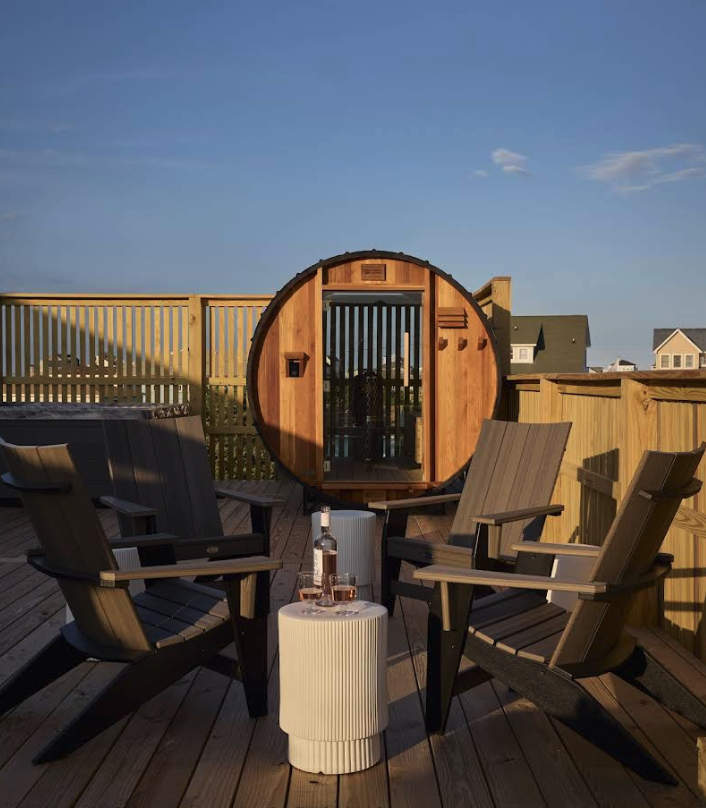
Too many properties plan a commercial sauna as a box to check on the amenities list — something guests expect, sized to whatever corner is left over after the pool and gym. That's the wrong frame, and it shows. A guest chose this property, with a limited amount of vacation or travel time, over every other place they could have stayed — an amenity that reads as an afterthought tells them their time wasn't worth the extra thought. Done right, a sauna is one of the few amenities left that can genuinely wow a guest, and that experience is exactly what turns into the revenue a general manager or spa director actually cares about — but only if the sauna is built for the guest volume a hotel or resort actually puts through it, and the business case behind it is built on real numbers, not a vibe.
The demand signal is real, and it's accelerating
Wellness tourism isn't a niche any more. Industry coverage puts the global wellness tourism market on track to exceed $1.4 trillion by 2027, and the shift in guest behavior behind that number is specific: travelers are increasingly booking based on how a stay will help them recover, not just how it will indulge them. The U.S. sauna services market itself — the commercial side, not home ownership — was valued at roughly $1.32 billion in 2026 and is projected to reach $1.96 billion by 2030, a 10.4% CAGR (Sauna Services Market Size, Competitors & Forecast to 2030, researchandmarkets.com). That's demand a property can either capture or watch a competitor capture first.
The behavioral signal shows up in smaller ways too: guests now post about a cold plunge and sauna session the way they used to post a poolside cocktail. That's earned social content a property doesn't have to pay an agency to produce.
The trajectory, in numbers:
Where the delight turns into revenue
A guest who steps out of a sauna into cold night air, or into a lake, remembers that stay differently than one who used the same treadmill they have at home. That's the experience worth building — and it happens to convert into revenue in two distinct ways, with most properties ending up using some blend of both:
Rate and positioning lift. A sauna doesn't have to be itemized to make money — for most hotels and resorts, it's folded into room rate and used to justify a higher tier or a "wellness" room category, the way a soaking tub or a fireplace does. Adjacent data from the short-term rental market gives a useful directional signal: vacation rental hosts adding a sauna report 15–30% higher achievable nightly rates and meaningfully higher occupancy, since guests actively filter listings for the amenity. A branded hotel or resort won't see identical numbers — the guest and booking dynamics are different — but the underlying mechanism (a sauna as a bookable differentiator, not a cost buried in overhead) holds at both scales.
Direct access fees. Where a property does itemize, day-spa-style access fees in the $20–40/session range are common, and premium membership or club tiers that bundle sauna access with other amenities tend to convert better than a sauna sold on its own.
Either model depends on the same precondition: the sauna has to still be a good sauna a year in, not a maintenance problem the front desk apologizes for.
The spec question hotels get wrong: build for the sessions, not the room count
Cedar shrinks as it dries and swells as it takes on moisture — that's normal for any barrel sauna. In a residential backyard, that cycle happens slowly, a handful of sessions a week. In a hotel or resort running a sauna 30-plus sessions a week, the same cycle happens fast and repeatedly, and most builders don't design for it. A flat-pack kit sauna is cut and assembled tight, ships tight, and then opens up at the joints as the wood moves under real commercial use — which is the kit vs. custom-built distinction showing up as a maintenance bill instead of an abstraction.
Nomad builds commercial units with that cycling accounted for from the start — stave fit, band tension, and joint geometry are all specified for sustained high-frequency use, not a showroom photo. The result is a barrel that's tight the day it's delivered and stays tight years into daily guest turnover, not just through the first season.
Nomad's commercial line at a glance:
Every size ships with the same clear-grade Western Red Cedar and band-compression joinery as Nomad's residential line, a 5-year build warranty, and custom branding — laser-engraved logos, branded window covers — for properties that want the sauna to read as part of the amenity, not a generic add-on. Lakefront resorts and waterfront wellness programs have a fifth option worth considering: a floating sauna on Nomad's aluminum-and-Ipê platform, which puts the hot-cold contrast experience — sauna to lake and back — directly on the property's own waterfront.
What actually differentiates a wellness amenity now
Luxury hospitality coverage points to a specific shift worth building the pitch to ownership around: guests are asking "how will I feel tomorrow?" instead of chasing pure indulgence, and properties that treat wellness as infrastructure woven through the guest journey — not a spa bolt-on — are the ones capturing that demand (HOTELSMag.com). A sauna sitting inside a proper wellness circuit — heat, cold, recovery — reads as infrastructure. A single unit wedged into an existing spa corner reads as an afterthought, even if the build quality is identical.
What to plan for before the sauna arrives
Commercial installations are permanent fixtures: a gravel pad, concrete slab, or platform deck, sized with 25–30% more clearance than a residential install to handle high-traffic movement around it. Properties considering ADA access should plan a ramp or approach path where local code or the use case calls for it, and proximity to restrooms and a cold-rinse or plunge option measurably increases how often guests actually use the amenity once it's installed. Lead time on a commercial build varies by spec — request a quote early in a renovation or amenity-planning cycle so it isn't the item holding up a launch date.
This article provides general information and is not legal, financial, or business advice. Revenue projections, amenity pricing models, permit requirements, and ADA compliance obligations vary by property, municipality, and use case. Consult a licensed attorney, CPA, or local building official before finalizing plans specific to your property.
FAQ
How much does a commercial sauna cost for a hotel or resort?
Pricing depends on size, stove type, and finish — request a quote for a spec built around your property and guest volume.
How long does a commercial sauna last under daily multi-guest use?
A sauna built for thermal cycling — proper stave fit, band tension, and joint geometry designed around repeated moisture and heat cycles — holds up to sustained commercial use for years. Nomad's commercial builds carry a 5-year warranty.
Does a sauna really increase hotel revenue, or is it just a cost?
It can do both, depending on the model. Properties that fold it into room rate and positioning, or charge direct access fees in the $20–40/session range, are turning it into a revenue line rather than pure overhead — but that only holds if the build survives the guest volume it's put through.
What size commercial sauna does a hotel actually need?
It depends on guest volume and how the amenity fits into a broader wellness area. A 12-ft unit suits a boutique property or day spa; 16- and 20-ft units fit full-service hotels, resorts, and high-traffic amenity floors. See the commercial sauna line for full specs.
Can a resort add a sauna to a lakefront or waterfront property?
Yes — Nomad's floating sauna line puts a sauna directly on the water on an aluminum-and-Ipê platform, which is a strong fit for lakefront resorts building out a hot-cold contrast experience.
Nomad builds commercial barrel saunas for hotels, resorts, and wellness properties from its workshop in Hudson, Wisconsin, and delivers them fully assembled nationwide. See the full commercial sauna line, browse locations and delivery, read how gyms and wellness centers are building the same business case, or request a quote to spec a build for your property.
Related saunas
- Custom backyard barrel saunas — Delivered fully assembled, ready to fire the first night.
- Custom barrel saunas, built to order — Backyard, mobile, floating, and commercial builds. No kits.