Culture 10 min read
The History of the Barrel Sauna
By Nomad Sauna
To understand why barrel saunas work (or don’t), you have to start before they existed, with the sauna as an act rather than an object.
In Finnish, sauna is one of the few native words that traveled into nearly every language on earth without translation. But in its original sense the word describes something you do more than somewhere you go. You do not just go to the sauna the way you go to a room. You go to sauna, the way you might say you go to sleep.
That distinction matters for the barrel. The barrel is not a clever reinvention of bathing. It is a return to the essentials of the practice: heat, stone, steam, wood, time, and people.
More Than Two Thousand Years of Finnish Sauna
The Finnish sauna tradition is usually dated back more than 2,000 years, with some regional histories tracing primitive pit-bathing in the region back much further, to the millennia after the last Ice Age. The earliest form was not a building at all. It was an excavated pit dug into a south-facing slope, covered with animal hides or turf, with a fire and a pile of stones inside. Heat the stones, seal the space, throw water. The stones are the machine. Everything since has been refinement.
That same principle shows up independently across the northern hemisphere, from the Nordic countries to the sweat lodges of Indigenous North America. In Finland the practice endured through the Bronze Age, the arrival of Christianity, foreign rule, and industrialization. There is an old Finnish saying that you build the sauna first and the house second. For much of Finnish history that was both a practical way of life and a spiritual one. The sauna was a shelter, washroom, birthing room, and smokehouse before the home was finished.
The Savusauna: The Original Built Form
The savusauna, or smoke sauna, is the oldest built sauna form still in use. It is a low, thick-walled log room with no chimney. A large pile of stones sits at one end, a fire burns under them for several hours, and the smoke fills the room and blackens every surface. When the fire dies down, the room is vented, the smoke clears, and the sauna is ready.
People who study Finnish sauna culture describe the savusauna heat as categorically different from anything modern: softer, denser, more radiant, because the heat comes from every blackened surface at once and not just the stones. Its problem (feature?) was always time and labor. As Finland urbanized through the 1700s and 1800s, the smoke sauna slowly gave way to something faster.
The Chimney, and the Bench That Came With It
Adding a chimney made the sauna a daily convenience instead of a half-day ritual. It heated faster, used less wood, and skipped the long venting. The form settled into what most people still picture as "a sauna": a rectangular log or framed room, a kiuas (stone heater) in the corner, and two-tier bench seating.
The two tiers are usually sold as tradition when they are really an adaptation. In a rectangular room, heat stratifies. Hot air collects at the ceiling and the lower half of the room stays cooler. The upper bench gets the real heat, the lower bench gets much less. Two-tier seating was the fix for a physics problem the rectangle created. The rectangle itself won out for construction reasons, not sauna reasons. Boxes are easier to frame, insulate, and roof. It was chosen because it was easy to build, not because it was the best shape to sit in.
Hold onto that point. It is the whole argument for the barrel.
How Deep the Sauna Runs in Finland
By the 20th century the sauna was inseparable from Finnish identity. Finland has roughly 3.2 million saunas for about 5.5 million people, and close to 90 percent of Finns sauna at least once a week. Business was done in the sauna. Diplomacy was done in the sauna. Births happened there, because the smoke-sterilized room was one of the cleanest spaces in a pre-modern home.
The sauna's first big international moment came at the 1952 Helsinki Olympics, where the Finnish hosts made a sauna available to athletes from around the world. For a lot of visitors it was their first sauna. Some were baffled. Some were converted. Decades later, in December 2020, UNESCO inscribed Finnish sauna culture on its Representative List of the Intangible Cultural Heritage of Humanity, a rare living practice, rather than a monument or artifact, to make the list. The UNESCO listing describes the heart of the practice as löyly, the steam, and the spirit, released when water hits the hot stones.
That word, löyly, is the tell that someone knows sauna. It is also the standard a real sauna has to meet: if you cannot throw water on the stones, it is a hot room, not a sauna.
Crossing the Atlantic: Sauna Comes to the Upper Midwest
The sauna's history in North America is mostly the history of Finnish immigration. Two waves brought it over: a first in the 1860s through the 1880s into the copper and iron country of Michigan's Upper Peninsula and Minnesota's Iron Range, and a much larger wave from the 1890s into the 1920s that spread Finnish communities across Wisconsin, Minnesota, Michigan, Oregon, and British Columbia.
These families rebuilt their culture as faithfully as they could, and the sauna was among the first structures they put up. The early North American saunas were close copies of the chimnied Finnish sauna: rough timber, rectangular, two-tier benches, a wood stove. You can still find the legacy across Michigan's U.P., Minnesota's Iron Range, and northwestern Wisconsin. This is the cultural backyard Nomad still builds in. Our shop is in Hudson, Wisconsin, in the heart of that upper-Midwest sauna country, and the build standards reflect a place where a sauna that could not handle a real winter would get found out fast.
For most of the 20th century, though, the outdoor sauna stayed an ethnic, heritage practice. Known to Scandinavian-Americans, mostly invisible to everyone else.
Where the Barrel Actually Came From
The shape was recognized, not invented. The barrel had been the form of cooperage for thousands of years before anyone put a stove in one. Precisely fitted staves pulled tight by compression bands translated almost directly to the problem of building a small, sealed, thermally efficient outdoor room. The logic is straightforward:
- No corners. Corners are the first failure point in outdoor wood construction. A cylinder has none.
- Even heat. The curved ceiling sets up a natural convection loop, which softens the harsh top-to-bottom stratification of a rectangular room. That is why a barrel can seat everyone on one level.
- Material efficiency. A circle encloses the most interior space for the least perimeter material.
- Self-draining. Condensation and rinse water run to the low point of the curve.
- Self-reinforcing. The staves press against one another under the bands. The structure holds itself together without a frame full of screws.
- Portable. A barrel can sit on cradle supports with minimal site prep and be moved without demolishing a foundation.
Built Like a Whiskey Barrel
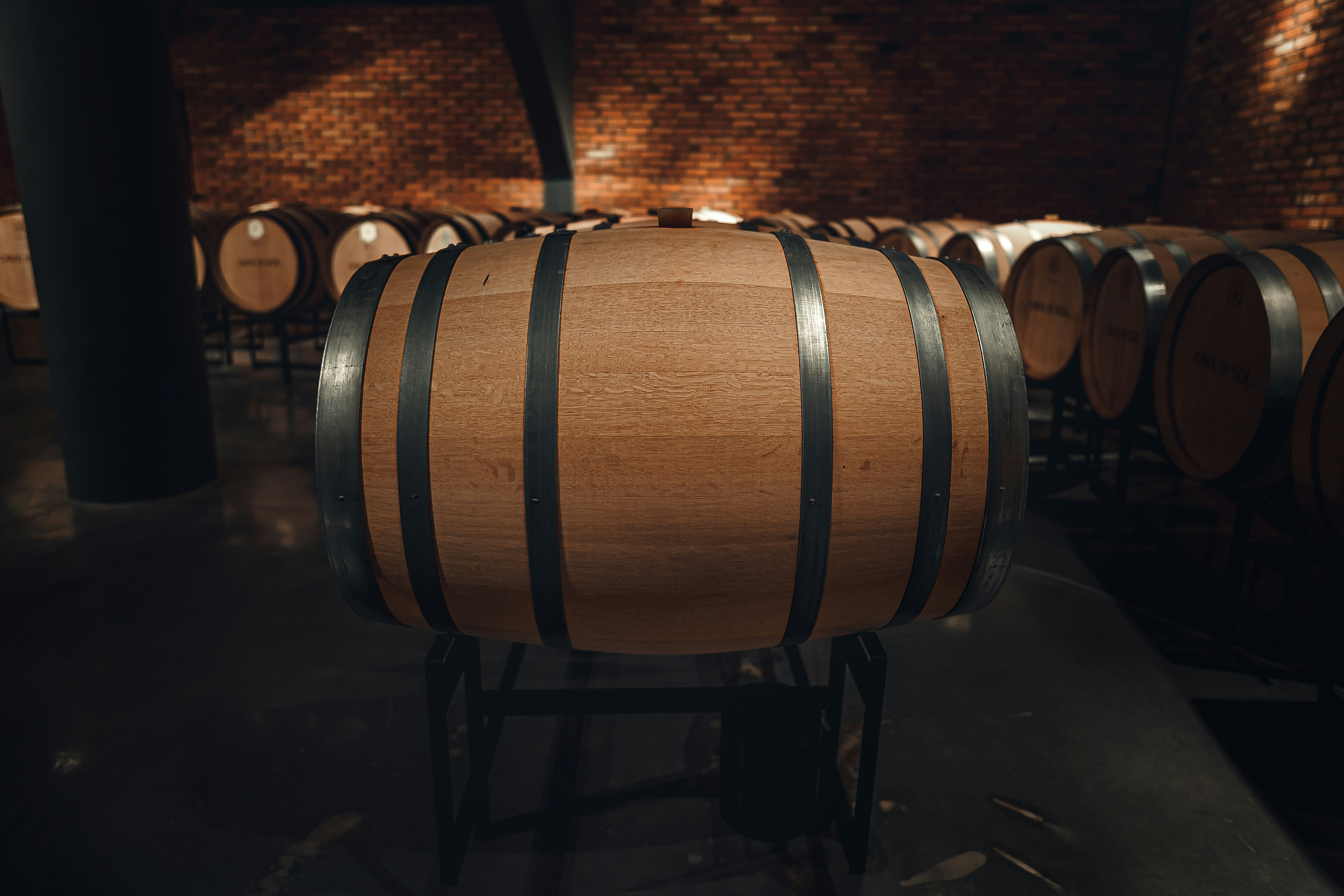
Cooperage — the craft of building watertight barrels from shaped wood staves — is roughly 5,000 years old. It predates iron nails. By the time the Romans were shipping wine and olive oil across the Mediterranean, the barrel was already the dominant form for storing and moving liquid over long distances, and the reason it worked then is the reason it still works now.
A standard bourbon barrel holds 53 gallons of liquid for years, often in warehouses with no climate control and real freeze-thaw cycling, with zero glue and zero fasteners. Geometry is the fastener. Staves are milled to precise radial angles and drawn together by steel compression bands, so the whole structure locks itself. As moisture swells the wood, the staves press harder against each other and the barrel gets tighter rather than looser. The construction logic does not fight the wood's natural movement. It embraces it.
That is the standard a real barrel sauna has to meet. A sauna built on this principle responds to heat and steam the way a whiskey barrel responds to weather: it swells into itself and holds. A sauna barrel that drives screws through the staves is cheaper to assemble and requires less precision in the milling, but it violates the principles that make a barrel work. It is a curved box. Over enough heat cycles, the screws win the argument with the wood, and the argument does not go well for the staves.
The other thing a real barrel does is look unmistakably like itself. The curved stave profile, the exposed compression bands, the clean round ends — you recognize a true barrel sauna from a hundred yards out. It does not look like outdoor furniture or a shed with a different roofline. The shape belongs in nature. Form follows compression, and the result is a silhouette that has not needed to change in five thousand years.
Why North America Built Barrels Out of Cedar
Traditional Finnish saunas used whatever the local forests provided: spruce, pine, aspen. Cedar is not native to Finland. North American builders reached for Western Red Cedar for reasons that hold up under heat:
- Natural oils (thujaplicins and thujic acid) make it resist moisture, rot, and insects without chemical treatment, and give it that cedar aroma people now associate with sauna itself.
- Dimensional stability. Cedar moves predictably through heat and moisture cycles, which matters enormously in a room that goes from freezing to 180°F and back.
- Low thermal conductivity. Bench and wall surfaces do not scald on contact at sauna temperatures.
- Light weight. Easier to work, easier on the cradle.
Clear-grade Western Red Cedar, the knot-free premium tier, machines cleanly and holds its tolerances. Knots are the weak spot: they heat faster than the surrounding wood and, over years of extreme cycling, can splinter, pop, or buckle under the band tension. That is what clear-grade is buying you.
The Second Wave: Wellness, Cold Plunge, and 2020
The barrel sauna stayed a specialty product through most of the 2000s, then several currents hit at once.
Cold-exposure went main stream. Ice baths, cold plunges, and contrast bathing created an audience that already understood the value of extreme temperature swings and just needed the hot half of the equation. A barrel installed next to a cold plunge became the natural infrastructure for that protocol. At the same time, resorts and boutique hotels installed barrel saunas as amenities through the 2010s, and guests took the idea home.
Then 2020 happened. The pandemic years pushed enormous spending into backyards, and the barrel sauna was a direct beneficiary. Search demand surged, kit makers sold out, and small custom builders found themselves with long backlogs. The category went mainstream in a way that would have looked impossible in 2010\.
Kit vs. Custom-Built: The Gap That Defines the Market Today
Mainstream availability did not settle the quality question. It sharpened it. The buyer researching a barrel sauna today sees everything from a flat-pack kit on a pallet to a fully custom build, and both get described with the same words: Western Red Cedar, authentic Finnish tradition, the transformative sauna experience.
This is the kit vs. custom-built divide, and it is the single most useful lens for evaluating any barrel sauna. A kit ships as a box of parts: thinner staves, knot-grade wood, screws driven into the staves, buyer assembly over a weekend. A custom-built barrel is shop-fitted from clear-grade cedar, assembled by the people who made it, and delivered complete. The defining construction difference is whether it is actually built like a barrel. A kit drives screws through the staves. Nomad's barrels use band-compression joinery — the same construction logic as any whiskey barrel, no fasteners through the wood — and the staves are milled to the tolerances that make compression hold. The wood is allowed to move, because it is a natural material and it wants to. A glued, screwed sauna fights that movement and loses.
Where the Barrel Goes From Here
The barrel is now a quintessential outdoor sauna shape in North America, and it shows up in places the box never could. Beside a cold plunge in a suburban backyard as a stationary residential build. On a trailer that moves between venues. On an aluminum platform as a floating sauna you step out of and straight into the lake. The shape sits naturally almost anywhere outdoors, needs no permanent foundation, and appears to belong in nature rather than impose on it. Curves are the language of the landscape, and the barrel is a curve.
The technologies at the center, heat, stone, steam, wood, and people, have not improved in two thousand years. They only have to be done correctly.
Frequently Asked Questions
How old is the barrel sauna?
The barrel shape is recent, most likely emerging in Scandinavia in the second half of the 20th century and reaching North America as a kit product in the 1990s and 2000s. The sauna practice it houses is far older, dating back more than 2,000 years in Finland.
Where did saunas originally come from?
Finland. The earliest form was an earth pit dug into a slope with a fire and heated stones inside, which evolved into the log smoke sauna (savusauna) and later the chimnied rectangular sauna most people picture today.
Why are saunas built in a barrel shape instead of a box?
The barrel has no corners (the main failure point in outdoor wood structures), heats more evenly thanks to the curved ceiling, uses material efficiently, drains itself, and holds together under compression without a screwed frame. The rectangle won out historically because boxes are cheaper to build, not because they are better saunas.
Why are barrel saunas made of cedar?
Western Red Cedar resists moisture, rot, and insects through its natural oils, stays dimensionally stable through heat cycling, does not scald on contact, and is light to work with. Clear-grade (knot-free) cedar is the premium tier because knots can splinter or pop under heat and band tension over time.
What is the difference between a kit barrel sauna and a custom-built one?
A kit ships as a flat-pack of parts for buyer assembly, often with thinner, knottier wood and screw construction. A custom-built barrel is shop-fitted from clear-grade cedar, held together with band-compression joinery, and delivered fully assembled. See the kit vs. custom-built buying guide.
Every Nomad barrel sauna is handbuilt in Hudson, Wisconsin and delivered fully assembled across the U.S. and Canada, not shipped as a box of parts. If you want to talk through which form fits your space, schedule a 30-minute consultation or request a quote.
Tags: Education
Related saunas
- Custom backyard barrel saunas — Delivered fully assembled, ready to fire the first night.
- Custom barrel saunas, built to order — Backyard, mobile, floating, and commercial builds. No kits.