Barrel Sauna Comparison 10 min read
Barrel Sauna Kit vs Custom-Built
By Nomad Sauna
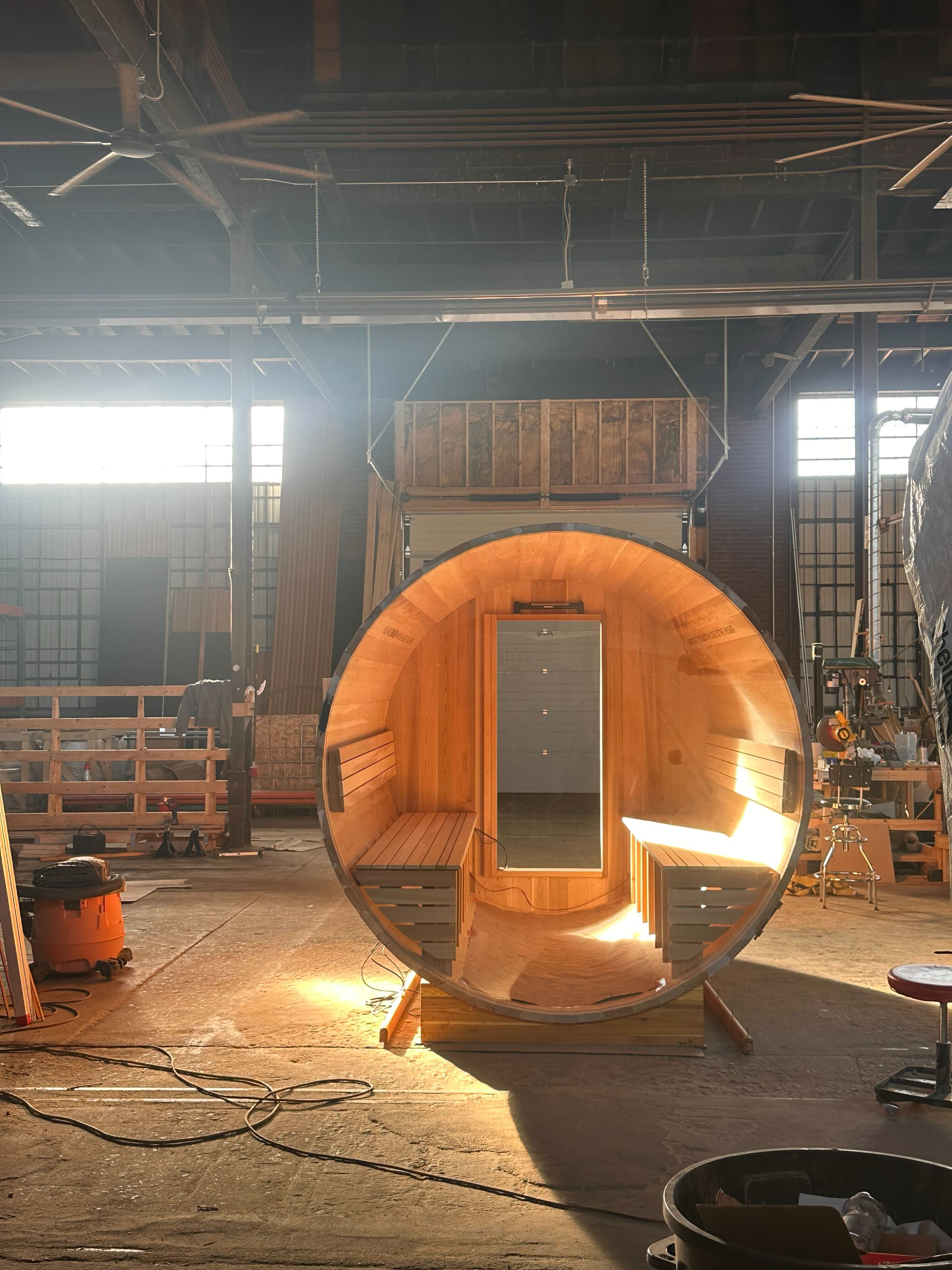
Barrel Sauna Kit vs Custom-Built Barrels
Walk into the U.S. barrel sauna market and the dominant format is the flat-pack kit. Costco, Wayfair, Amazon, and the two largest specialty retailers (Almost Heaven and Redwood Outdoors) all sell kits. Custom-built barrel saunas exist, but they're the minority. From a photo, the two look the same. From a product page, they read the same. The difference shows up around year five when the kit barrel starts to open, the screw heads work loose under thermal cycling, and the wood that was sold as "premium" reveals what "premium" actually meant.
Kit vs. custom-built is the single most useful frame for evaluating a barrel sauna. It's the lens the Nomad Buyer's Guide is built around. It's the one this post will give you.
Short answer: A barrel sauna kit ships as a flat-packed crate of pre-cut staves, bands, and hardware that the customer assembles on a foundation in their yard. A custom-built barrel sauna is built from scratch and assembled start to finish in a shop, then delivered as one finished piece. The build methods are different. The materials are different. The lifespan is different. The price reflects the gap.
Below: what each one actually is, what they're built from, and which one matches what you want.
What "kit" means in this category
A barrel sauna kit is a flat-pack. Pre-cut tongue-and-groove staves, end caps, bands, hardware, an electric heater, sometimes a bench bundle. The customer assembles it using printed instructions and basic tools.
The two best-known U.S. brands selling this format:
- Almost Heaven Saunas — their flagship 4–6 person model, the Kuuma, is built from thermally modified Nordic Pine at 1⁹⁄₁₆" stave thickness, held with stainless steel bands, hinges, and fasteners. Country of origin: Romania. Shipping lead time: 6–8 weeks. Pricing in the low $10Ks at list, per their published product page.
- Redwood Outdoors — barrel saunas built from heat-treated hemlock with tongue-and-groove staves held by stainless steel bands and fasteners. Ships as a flat-pack kit; advertised assembly time of "a few hours using basic construction skills."
There are dozens of others, and the build pattern is consistent across the category. Pre-cut staves. Screwed or stapled into a frame. Stainless bands on the outside. Shipped from overseas in most cases. Assembled on the customer's property.
That's the kit category. It's the bulk of barrel saunas in the U.S. market.
What "custom-built" means at Nomad
A Nomad barrel sauna is built from scratch and assembled start to finish in our Hudson, Wisconsin shop, then delivered as one finished piece. Not flat-packed. Not screw-assembled on-site. Hand-made, then craned or rolled into place where it lives.
The core build:
- Clear-grade Western Red Cedar, 1.5" thick, tongue-and-groove staves. Clear-grade means no knots, the premium tier of cedar lumber.
- Band-compression joinery: stainless bands compress the staves into a sealed cylinder. No glues. No screws. The wood is held by tension, not fasteners.
- Tempered glass end cap. Steel corrugated roof. Cedar exterior, or an optional hand-charred yakisugi torched exterior.
- Built to spec: three sizes (8, 10, 12 ft), three stove types (electric Homecraft, wood-fired IKI, propane Torch), and configurable upgrades.
"Custom-built" means each barrel is built to order in the shop, not pulled off a pallet and shipped. Lead time runs 12–16 weeks because of that. The comparison, on the axes that matter
Sources: Almost Heaven Kuuma product page, Redwood Outdoors assembly guide, Nomad workshop specs.
Why band-compression joinery matters
The structural challenge here is thermal cycling. 180°F heat for 90 minutes, three or four times a week, for the life of the unit. Wood expands when it absorbs heat. Contracts when it cools. Over thousands of cycles, it moves.
There are two ways to handle that movement.
The kit way: Screw the staves into a frame. Glue the joints where the staves meet. Use the stainless bands as decoration and tension assistance. When the wood moves, the screws fight the wood. They loosen. Glue joints stress and eventually fail. The barrel opens. When the wood shrinks, the staves shrink apart from their neighbors, and gaps appear.
The custom-built way: No screws in the staves. No glue. The stainless bands are the only thing holding the barrel together — they compress the staves into a sealed cylinder. As the wood shrinks, the bands tighten. As the wood swells, the bands give a little. The structure self-adjusts.
This is what's meant by band-compression joinery. It isn't how kit barrels are built. It isn't optional, decorative, or marketing. It's the structural method, and it changes what the barrel does over time.
The practical consequence: a kit barrel and a custom-built barrel both look tight on day one. By year five, the difference becomes visible and felt on the kit. Stave gaps. Loose bands. Screw heads backing out. Glue joints separating in the heat. A Nomad barrel built ten years ago still seals shut because the band system never stopped doing its job.
There's a second consequence that matters in a heated room. A glued sauna off-gasses — the adhesive vapors release at temperature. In a custom-built barrel with no glue, the only thing in the air is the cedar.
Clear-grade cedar vs. knotty thermal softwood
Almost Heaven's barrel saunas are built from thermally modified Nordic Pine. Redwood Outdoors uses heat-treated hemlock. Both are decent choices. Neither is Western Red Cedar, and neither is clear-grade.
What clear-grade buys is the absence of knots. Knots aren't just cosmetic. Knots are denser than the surrounding wood. They heat hotter and faster. Over time, exposed to hot-and-cold extremes and high moisture, knots are the points where lumber splinters, pops, or buckles under the pressure of the banding. A barrel sauna with knots has more failure points than a barrel sauna without.
Western Red Cedar separately brings:
- Natural rot resistance
- Lower thermal conductivity than pine or hemlock means gentler benches and walls at 180°F
- Aromatic compounds that make a cedar sauna smell like a cedar sauna
That last one isn't sentimental. The aromatic oils are part of what most sauna buyers are actually paying for. They aren't present in thermally modified pine or hemlock in the same way, because the heat treatment that gives those woods their rot resistance also drives off most of the volatile compounds.
This is the part of the build the kit category can't replicate at the kit price point. Clear-grade WRC at 1.5" thickness costs significantly more than thermal pine at 1⁹⁄₁₆", and the difference compounds across the 50-some staves in a barrel.
What you're actually signing up for with a kit
Kit assembly instructions read "basic construction skills, a few hours." The reality is closer to a full day with a helper, plus a separate electrician visit, plus inevitable troubleshooting.
What kit assembly involves:
- Site preparation: a level concrete pad or 4–6" compacted gravel base
- Unpacking the crate, sorting staves, end-cap panels, bands, brackets, fasteners
- Building the cradle base, assembling the front and rear end caps
- Stacking and aligning the tongue-and-groove staves around the end caps
- Tightening the stainless bands progressively as the cylinder closes up
- Installing the door, glass, roof, benches, and heater bracket
- Electrical hookup (240V / 40A typical for kit heaters) requires a licensed electrician
- First-fire / break-in cycle
If a stave is bowed, cracked in transit, or out of tolerance, the customer finds out during step 4 or 5, after committing hours of labor. Most kits ship from overseas, which means warranty claims on damaged lumber move at the pace of international logistics.
What custom-built delivery looks like at Nomad:
- Customer preps the site: gravel pad, 7' wide × length of sauna, 5" deep. A landscaper handles it in a couple of hours.
- Customer hires a licensed electrician for a 240V / 50A circuit.
- Nomad delivers the barrel fully assembled.
- A crane (Nomad coordinates; customer pays) sets it on the pad.
- Electrician connects power.
- First fire.
The trade-off is honest. Nomad's lead time is longer — 12–16 weeks vs. 6–8 weeks for a typical kit. The build itself takes weeks in the workshop instead of a day in the customer's yard. What that buys is the elimination of assembly risk, kit-component variance, and the long-tail of fastener and joint failures the kit pays back over time.
What 30 years of ownership looks like
Buyers ask about price first because they don't yet have the frame to ask about anything else. The frame that matters is what does this cost per use, over the years the customer will own it.
A kit barrel sauna at a typical price point lasts 5–10 years in regular residential use before structural issues require either major repair or replacement. The common failure modes: stave gapping, band loosening past serviceable tension, fastener failure at heat-stressed points, lumber checking and cracking at knot locations, and door-frame distortion as the end-cap panels shift.
A custom-built barrel sauna built with band-compression joinery, clear-grade WRC, and 1.5" staves is designed for a generation of use. Nomad's 5-year build warranty covers manufacturing defects; the structural method is engineered to outlast the warranty by decades. Operating cost is small on electric, roughly $20 per month for a four-session-a-week household.
The cost-per-session math, directionally:
- Kit at ~$11K, replaced every 8 years, 4 sessions/week → starts low, but every replacement resets the meter. Across 30 years, the kit gets bought three or four times.
- Custom-built, one-time, 30-year service life, 4 sessions/week → keeps amortizing across the same purchase. Cost-per-session keeps falling as long as the barrel is in service.
These are rough numbers. Real-world costs vary by site prep, electrical, climate, and use pattern. The directional truth holds: a custom-built barrel sauna is a different cost per use over its lifespan, even at a higher upfront price. The buyers who run the math tend to land in the same place.
Request a quote to see what the numbers look like at the size and configuration that fits the site.
When a kit is the right choice
Custom-built isn't the answer for every buyer. A kit barrel sauna makes sense if:
- The budget ceiling is firm and below the custom-built band
- The buyer enjoys assembly work and has the help to do it well
- A 5–10 year ownership horizon is acceptable, with replacement budgeted in
- Use will be light — once or twice a week
- You love buying saunas so much you want to do it again in 5 years
For those situations, Almost Heaven and Redwood Outdoors are credible kit options. The build is what it is, and they don't pretend otherwise.
Custom-built makes more sense when the sauna will be used hard, lived with for decades, and treated as an installed structure rather than a backyard product. That's the buyer Nomad is built for.
FAQ
Are kit barrel saunas worth it?
A kit barrel sauna is worth it for a buyer with a firm budget ceiling, light expected use, and tolerance for a 5–10 year ownership horizon. For heavy use or generational ownership, the kit construction method becomes a liability around year five.
How long does it take to assemble a barrel sauna kit?
Manufacturer advertised assembly times range from "a few hours" (Redwood Outdoors) to a full day with a helper for larger 6-person kits. Realistic time including site prep, troubleshooting, and electrician scheduling is typically 2–4 days end to end.
Are Almost Heaven barrel saunas made in the USA?
No. Almost Heaven's barrel saunas are manufactured in Romania, then shipped to the U.S. as a flat-pack kit. Nomad's barrel saunas are built in Hudson, Wisconsin and delivered fully assembled.
What's the difference between cedar and thermal pine in a barrel sauna?
Western Red Cedar is naturally rot-resistant, lower in thermal conductivity (cooler to the touch at sauna temps), and aromatic without treatment. Thermal Nordic Pine is heat-treated to improve rot resistance and dimensional stability, but it starts as a higher-conductivity wood with more knot density at standard grades, and the thermal treatment that gives it rot resistance also drives off most of the aromatic compounds. Clear-grade cedar is the premium tier.
Do I need a building permit for a barrel sauna on my property?
For private residential use on owner-occupied property, most U.S. jurisdictions classify a barrel sauna as an accessory structure that doesn't require a building permit, especially when it's set on a gravel pad with no slab pour. Rules change for commercial installs, rental operations, and some HOAs and municipalities.
Permit requirements for accessory structures vary by municipality and HOA. While barrel saunas installed for personal use on private residential property generally don't require building permits in most U.S. jurisdictions, always verify with the local building department before installation.
The decision
A kit barrel sauna is a flat-pack of pre-cut lumber and hardware assembled in the customer's yard. A custom-built Nomad barrel sauna is built from scratch and assembled start to finish in our Hudson, Wisconsin shop, then delivered as one finished piece. The first costs less and lasts under a decade. The second costs more and lasts a generation.
For most buyers, the question isn't which one is "better" in the abstract. It's which one matches the time horizon, the use intensity, and the budget that fits the situation.
If the build details still feel abstract, the Nomad Buyer's Guide walks the kit-vs-custom-built lens through every spec that matters. The easiest next step is a quote or a call with the workshop.
Tags: custom sauna, kit sauna, comparison
Related saunas
- Custom barrel saunas, built to order — Backyard, mobile, floating, and commercial builds. No kits.
- Barrel sauna buyer's guide — Cost, sizing, and kit vs. custom — what to ask any builder.
- Request a backyard design consultation — Tell us about your property. We'll design a sauna around it.